Introduction
Plant management software is a digital solution that helps factories and industrial facilities manage production, maintenance, equipment, inventory, and quality from one centralized platform. Instead of relying on spreadsheets, paper records, or disconnected systems, manufacturers can monitor their entire operation in real time and make faster, data-driven decisions.
Modern manufacturing plants face constant pressure to reduce downtime, increase productivity, and maintain consistent product quality. Manual processes often lead to missed maintenance schedules, inaccurate inventory records, delayed work orders, and poor communication between departments. These challenges can increase operating costs and reduce overall efficiency.
By implementing plant management software, businesses can automate routine tasks, improve equipment reliability, optimize production schedules, and gain valuable insights through live dashboards and analytics. Industries including automotive, food processing, pharmaceuticals, chemicals, power generation, and packaging all benefit from these systems.
In this guide, you’ll learn how plant management software works, its core features, different software types, major business benefits, essential integrations, key performance indicators, and how to choose the right solution for your facility.
What Is Plant Management Software?
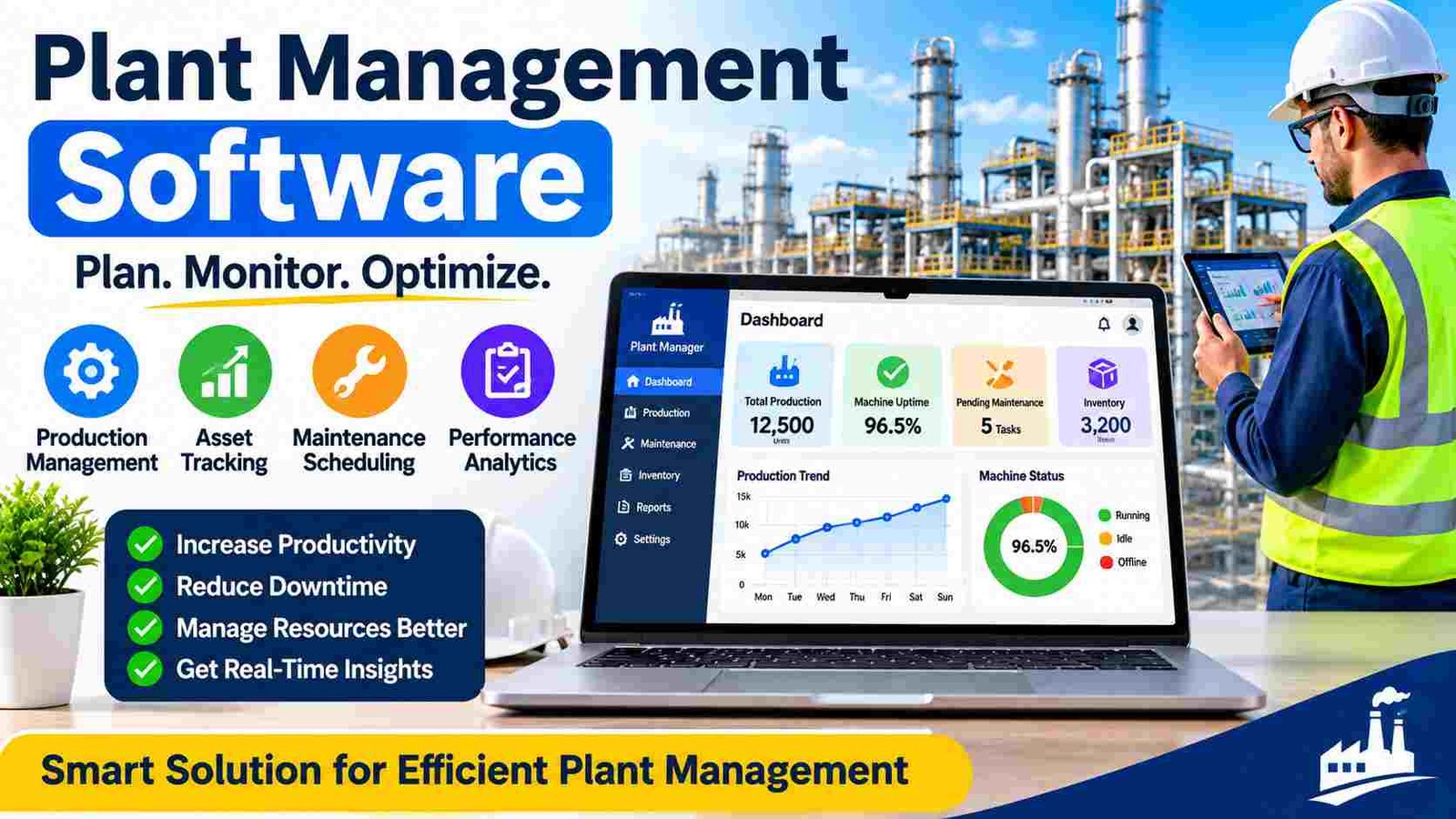
Plant management software is an integrated digital system designed to oversee and optimize daily operations within a manufacturing or industrial plant. It combines maintenance management, production planning, asset tracking, inventory control, quality monitoring, and reporting into a single platform that gives managers complete visibility over factory performance.
Unlike general business software, which focuses mainly on accounting, sales, or human resources, plant management software is specifically built for industrial environments. It connects machines, equipment, technicians, production lines, and operational data, allowing every department to work with the same accurate information.
The primary goal of plant management software is to improve operational efficiency while reducing equipment downtime and unnecessary costs. It helps organizations maintain high product quality, improve workplace safety, and extend the lifespan of valuable assets through preventive and predictive maintenance strategies.
Today, many manufacturers consider plant management software the digital backbone of smart factories. When integrated with ERP systems, IoT sensors, and manufacturing equipment, it creates a connected environment where production decisions are based on real-time information rather than manual reports. This enables businesses to respond quickly to issues and continuously improve operational performance.
How Plant Management Software Works?
Plant management software follows a structured workflow that connects every stage of plant operations. It begins by creating a digital record for each machine, asset, and production resource. Every piece of equipment receives its own maintenance history, warranty information, location, and performance records.
Production planners then create schedules based on customer demand, available capacity, machine availability, and workforce shifts. Once production begins, supervisors can generate digital work orders for maintenance teams whenever inspections, repairs, or service activities are required.
Preventive maintenance is automatically scheduled according to calendar dates, machine operating hours, or production cycles. The software sends reminders to technicians before maintenance is due, helping prevent unexpected equipment failures.
Inventory management continuously tracks spare parts, tools, and maintenance supplies. Barcode or RFID scanning improves stock accuracy and automatically alerts purchasing teams when inventory reaches minimum levels.
During daily operations, shop floor data is collected from machines, PLCs, and IoT devices. Managers can view production output, machine utilization, downtime, and maintenance status through live dashboards. Finally, built-in analytics calculate important KPIs such as Overall Equipment Effectiveness (OEE), MTBF, MTTR, and production efficiency, providing valuable insights for continuous improvement.
Core Features of Plant Management Software
The strength of plant management software lies in its ability to combine multiple operational functions into one intelligent platform. Each feature contributes to improving productivity, reducing downtime, and increasing visibility across the manufacturing facility.
Asset Management
Asset management creates a complete digital profile for every machine and piece of equipment. Managers can monitor the entire lifecycle of assets, including installation dates, maintenance history, warranty details, depreciation records, and replacement schedules. This information helps organizations make better investment decisions while maximizing equipment lifespan.
Work Order Management
Digital work orders replace paper-based maintenance requests. Employees can submit repair requests instantly, while supervisors assign technicians based on priority and availability. The software tracks progress from creation to completion, ensuring every maintenance task is documented and completed efficiently.
Preventive Maintenance Scheduling
Preventive maintenance automatically schedules inspections and servicing before equipment fails. Maintenance plans may be calendar-based, meter-based, or usage-based depending on the machine. Automated notifications help technicians complete maintenance on time and reduce costly emergency repairs.
Predictive Maintenance
Advanced systems use IoT sensors to monitor vibration, temperature, pressure, and machine condition. By analyzing these readings, the software identifies early signs of wear and predicts potential failures before they interrupt production.
Production Planning and Scheduling
Production scheduling helps manufacturers balance machine capacity, workforce availability, customer orders, and delivery deadlines. Managers can optimize shift planning and reduce production bottlenecks for better throughput.
Inventory and Spare Parts Management
Spare parts management ensures critical components are always available. Barcode and RFID technology improve inventory accuracy, while automatic reorder alerts prevent stock shortages and production delays.
Quality Management
Quality modules support inspection checklists, defect reporting, batch traceability, and compliance documentation. Manufacturers can maintain consistent product quality while meeting industry standards and audit requirements.
Mobile Maintenance Applications
Mobile access allows technicians to receive work orders, perform inspections, attach photos, collect digital signatures, and update maintenance records directly from smartphones or tablets, even in offline environments.
Types of Plant Management Software
Different manufacturing facilities require different types of software depending on their operational goals. Some businesses focus primarily on maintenance, while others require complete production execution or enterprise-wide asset management.
| Software Type | Primary Purpose |
| CMMS | Maintenance management and preventive maintenance |
| EAM | Enterprise-wide asset lifecycle management |
| MES | Manufacturing execution and shop floor control |
| ERP Plant Module | Production integrated with finance and procurement |
| SCADA/PIMS | Real-time process monitoring and automation |
| QMS | Quality inspections and compliance management |
A CMMS is ideal for organizations that want to improve maintenance efficiency. EAM platforms suit asset-intensive industries such as utilities and transportation. MES systems are best for manufacturers requiring detailed production control, while ERP plant modules connect manufacturing with business operations like purchasing and finance. SCADA/PIMS solutions specialize in real-time industrial monitoring, and QMS platforms help organizations maintain regulatory compliance and product quality.
Benefits of Plant Management Software
Implementing plant management software delivers measurable improvements across production, maintenance, quality, and financial performance. Rather than solving one operational problem, it creates a connected environment where every department shares accurate information.
Reduce Unplanned Downtime
Scheduled maintenance and predictive monitoring help identify equipment issues before they become serious failures. Faster repairs and better planning minimize production interruptions and improve equipment availability.
Increase Equipment Reliability
Consistent maintenance schedules extend machine life and reduce wear. Historical maintenance records also help technicians diagnose recurring problems more efficiently.
Improve Production Efficiency
Better production planning allows manufacturers to maximize machine utilization, reduce idle time, and increase throughput without unnecessary overtime or scheduling conflicts.
Lower Operating Costs
Automated maintenance, optimized labor allocation, and improved inventory control reduce maintenance expenses, emergency repairs, and excess spare parts purchasing.
Better Regulatory Compliance
Digital inspection records, safety checklists, and audit-ready documentation simplify compliance with ISO standards and industry regulations while improving workplace safety.
Real-Time Decision Making
Live dashboards provide managers with instant visibility into production output, downtime, quality metrics, and maintenance status. This allows faster decisions based on reliable operational data instead of delayed manual reports.
Industries That Use Plant Management Software
Plant management software is valuable wherever machinery, production processes, or industrial assets require careful coordination. Manufacturing companies use it to improve production planning, equipment maintenance, and operational visibility across multiple production lines.
The food and beverage industry depends on the software for hygiene compliance, batch traceability, and preventive maintenance of processing equipment. Pharmaceutical manufacturers use it to maintain strict quality standards, document inspections, and support regulatory compliance.
In chemical processing, continuous monitoring helps improve safety and reduce operational risks. Oil and gas facilities rely on asset management and predictive maintenance to maximize equipment reliability in demanding environments. Automotive manufacturers benefit from production scheduling, robotics integration, and quality control throughout assembly operations.
Other major users include power generation, cement and steel plants, paper and pulp mills, and packaging manufacturers. Although each industry has unique operational requirements, they all share common goals: reducing downtime, improving productivity, increasing equipment reliability, and making better decisions through real-time operational data.
Plant Management Software vs ERP vs CMMS
Many businesses confuse these three systems because they often work together. However, each serves a different purpose within industrial operations.
| Feature | Plant Management | ERP | CMMS |
| Asset tracking | ✔ | Limited | ✔ |
| Production scheduling | ✔ | ✔ | ✘ |
| Maintenance | ✔ | Limited | ✔ |
| Inventory | ✔ | ✔ | Partial |
| Quality | ✔ | Partial | ✘ |
| Financials | Limited | ✔ | ✘ |
A CMMS is the best choice for maintenance-focused organizations that want to improve equipment servicing. An ERP manages company-wide finance, procurement, and business processes. Plant management software combines maintenance, production, quality, inventory, and operational monitoring, making it the most comprehensive solution for manufacturing facilities. Many large enterprises integrate all three systems to create a fully connected digital manufacturing environment.
Essential Integrations
Integrations allow plant management software to exchange information with other business and industrial systems, eliminating duplicate data entry and improving operational accuracy.ERP systems such as SAP, Oracle, and Microsoft Dynamics synchronize purchasing, inventory, finance, and production planning. This creates a seamless flow between manufacturing and business operations.
MES platforms provide detailed shop floor visibility by connecting production orders, machine performance, and manufacturing execution. SCADA and PLC systems collect live machine data, enabling real-time monitoring of equipment status, alarms, and production processes.
IoT sensors enhance predictive maintenance by continuously measuring temperature, vibration, pressure, and energy consumption. These readings help identify equipment problems before failures occur.
Finally, accounting software supports cost analysis, maintenance budgeting, and financial reporting. Together, these integrations transform plant management software into a centralized operational hub that improves decision-making across the entire manufacturing organization.
Key KPIs Tracked by Plant Management Software
Measuring performance is essential for continuous improvement. Plant management software automatically calculates operational KPIs that help managers evaluate equipment efficiency, maintenance effectiveness, and production performance.
Overall Equipment Effectiveness (OEE) measures machine availability, performance, and quality. It is one of the most important indicators of manufacturing productivity. Mean Time Between Failures (MTBF) evaluates equipment reliability by measuring how long machines operate before experiencing failures.Mean Time To Repair (MTTR) shows how quickly maintenance teams restore equipment after breakdowns. Lower MTTR usually indicates more efficient maintenance processes.
Other valuable metrics include downtime percentage, maintenance backlog, asset utilization, production output, and energy consumption. These KPIs help organizations identify operational weaknesses, reduce waste, improve resource utilization, and support data-driven improvement initiatives across the manufacturing plant.
How to Choose the Best Plant Management Software?
Selecting the right plant management software requires more than comparing features. Businesses should begin by identifying whether they operate a single facility or multiple plants, along with the complexity of their production processes.
Ease of use is equally important. A simple interface encourages faster adoption among technicians, supervisors, and production managers. Mobile applications should support Android and iOS devices while offering offline functionality for areas with limited connectivity.
Integration capabilities deserve careful attention. The software should connect easily with existing ERP systems, manufacturing equipment, IoT devices, and accounting platforms through APIs or built-in connectors.
Scalability ensures the solution can grow alongside the business by supporting additional production lines, facilities, and users. Finally, evaluate the total cost of ownership, including software licensing, implementation, employee training, technical support, and future upgrades. Choosing a solution that balances functionality, usability, and long-term value will provide the greatest return on investment.
Best Plant Management Software Solutions
The market offers many reliable plant management software platforms designed for different business sizes and operational needs. Rather than identifying a single winner, it’s more useful to understand which solution fits specific manufacturing requirements.
| Software | Best For |
| SAP Plant Maintenance | Large manufacturing enterprises |
| IBM Maximo | Asset-intensive industries |
| Fiix CMMS | Mid-sized manufacturers |
| UpKeep | Mobile maintenance teams |
| MaintainX | Digital work order management |
| Limble CMMS | Preventive maintenance programs |
| eMaint | Multi-site industrial operations |
Each platform offers different strengths, including maintenance automation, asset management, production visibility, mobile access, and enterprise integrations. Businesses should evaluate their operational requirements before selecting a solution that aligns with their maintenance and production goals.
Common Implementation Challenges
Even the best plant management software requires careful implementation to achieve successful results. One of the biggest challenges is employee resistance, especially when teams are accustomed to paper-based processes or older software systems. Clear communication and practical training help improve user adoption.
Poor data migration is another common issue. Inaccurate equipment records, missing maintenance history, and duplicate asset information can reduce the effectiveness of the new system. Organizations should clean and verify data before migration begins.
Incomplete asset documentation often makes preventive maintenance difficult during the early stages of implementation. Creating a standardized asset hierarchy improves long-term reporting and maintenance planning.
Integration complexity may also arise when connecting ERP systems, PLCs, IoT devices, and legacy manufacturing equipment. A phased implementation strategy reduces risk by introducing features gradually while allowing employees to adapt to new workflows. Strong change management, leadership support, and ongoing training are essential for long-term success.
Future Trends in Plant Management Software
Manufacturing technology continues to evolve rapidly, and plant management software is becoming more intelligent every year. Artificial intelligence now helps maintenance teams predict equipment failures by analyzing historical and real-time operational data.
Machine learning improves production planning by identifying patterns that optimize machine utilization and reduce waste. Digital twins create virtual models of factories, allowing engineers to simulate production changes before implementing them in the real world.
The growth of the Industrial Internet of Things (IIoT) enables thousands of connected sensors to provide continuous monitoring of machines, energy usage, and environmental conditions. Cloud-native platforms make remote access, automatic updates, and multi-site management easier than traditional on-premise systems.
Edge computing reduces latency by processing critical machine data closer to equipment, while sustainability features help manufacturers monitor carbon emissions and energy consumption. These innovations are transforming plant management software into a key technology for smart, efficient, and environmentally responsible manufacturing.
Frequently Asked Questions
1. What is plant management software used for?
Plant management software helps manufacturers manage production, maintenance, inventory, quality, assets, and operational reporting from one centralized digital platform.
2. Can small manufacturing companies use plant management software?
Yes. Many cloud-based solutions are designed specifically for small and medium-sized manufacturers, offering affordable pricing and scalable features.
3. How does predictive maintenance improve factory performance?
Predictive maintenance uses sensor data and analytics to detect early equipment problems, helping businesses prevent unexpected breakdowns and reduce repair costs.
4. Is plant management software suitable for multiple factory locations?
Yes. Many enterprise platforms support multi-site operations, allowing managers to monitor equipment, production, and maintenance across several facilities from one dashboard.
5. How long does it take to implement plant management software?
Implementation time depends on company size and system complexity. Small facilities may complete deployment within weeks, while large enterprise projects can take several months.
Conclusion
Plant management software has become an essential tool for modern manufacturing and industrial operations. By combining maintenance, production planning, asset management, inventory control, quality monitoring, and real-time analytics into one platform, it helps organizations improve efficiency while reducing downtime and operational costs.
Whether you manage a single factory or multiple production facilities, choosing the right plant management software can increase equipment reliability, improve decision-making, and support long-term business growth. As technologies such as AI, IoT, digital twins, and cloud computing continue to advance, manufacturers that invest in connected digital operations will be better positioned to achieve higher productivity, greater sustainability, and stronger competitive performance.