Introduction
The event and entertainment industry depends on perfect timing, organized equipment, and excellent customer service. Audio visual rental software helps businesses manage every stage of the rental process, from customer inquiries and quotations to equipment delivery and returns. Instead of relying on spreadsheets or paper records, companies can control inventory, bookings, contracts, and staff from one centralized system.
Manual scheduling often leads to double bookings, misplaced equipment, delayed deliveries, and inaccurate invoices. These problems not only reduce productivity but also affect customer satisfaction and business profits. Modern AV rental software solves these challenges with real-time inventory tracking, automated quotations, barcode scanning, and digital scheduling.
Today, event production companies, wedding suppliers, corporate conference providers, schools, broadcasters, and stage lighting businesses all use digital rental management systems to simplify daily operations. Whether a company rents microphones, projectors, LED walls, or complete event production packages, the right software improves efficiency and helps teams deliver professional service.
In this guide, you’ll learn what audio visual rental software is, how it works, its essential features, the best solutions available, and how to choose the right platform for your business.
What Is Audio Visual Rental Software?
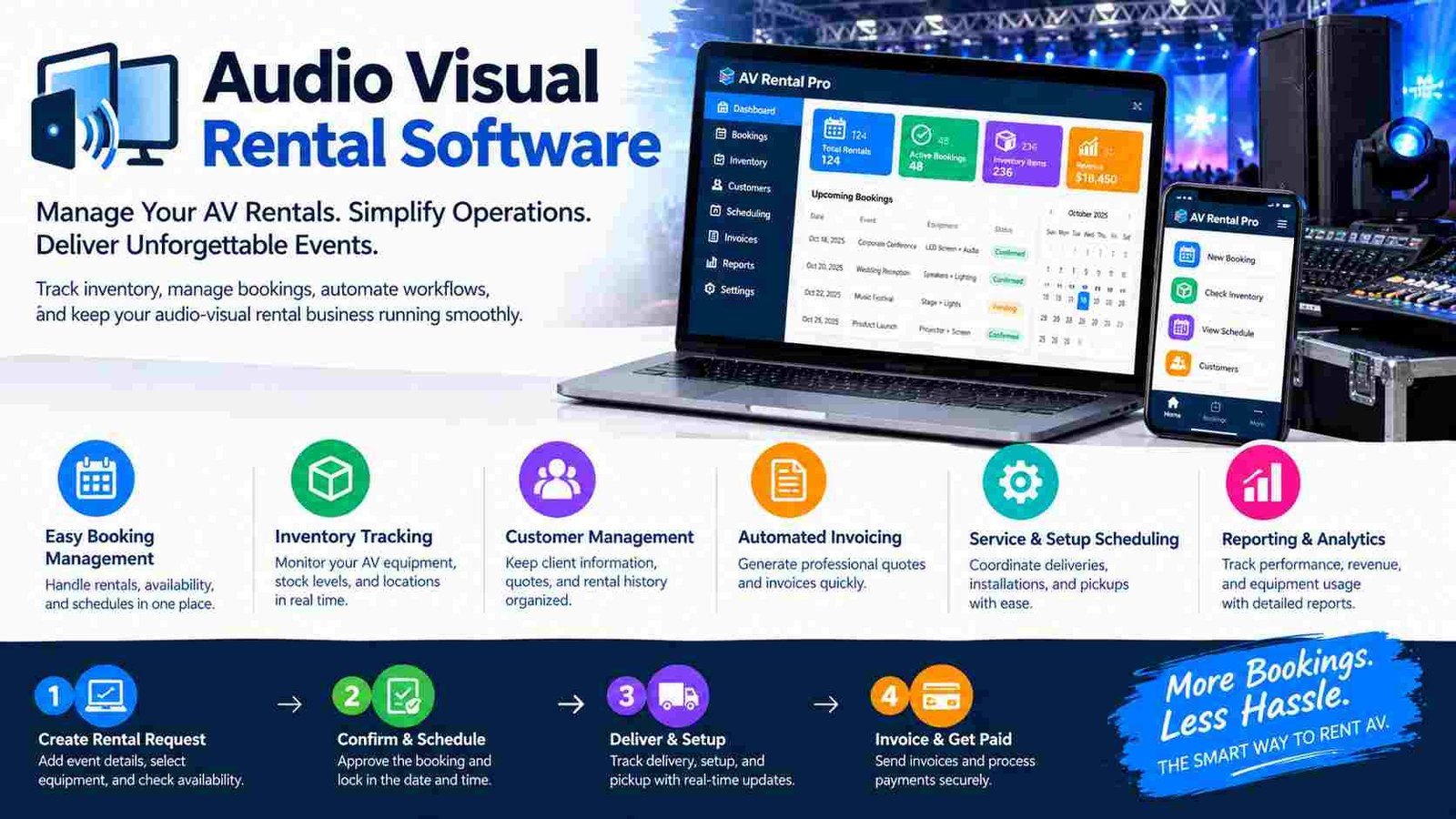
Audio visual rental software is a specialized business management system designed for companies that rent audio, video, lighting, staging, and presentation equipment. Unlike general rental software, it includes tools specifically built for managing complex AV inventories, event scheduling, equipment kits, technicians, and logistics.
The primary goal of this software is to bring every business operation into one platform. Sales teams can create quotations, warehouse staff can prepare equipment, technicians receive job assignments, and managers can monitor inventory and revenue through live dashboards. This reduces communication errors and improves workflow across departments.Many industries benefit from AV rental software. Event production companies use it to coordinate concerts and festivals, while corporate conference providers manage projectors, displays, and sound systems for business events. Wedding companies schedule lighting and DJ equipment, educational institutions organize classroom technology, and broadcasting organizations manage cameras and streaming equipment. Because every rental item is tracked individually, businesses gain better visibility into equipment availability and maintenance history.
For growing companies, centralized management becomes especially valuable. Instead of switching between spreadsheets, emails, accounting software, and calendars, everything is connected in one digital workspace, saving time and improving operational accuracy.
How Does Audio Visual Rental Software Work?
The workflow of audio visual rental software follows the complete customer journey, making rental management faster and more organized. Each stage is connected so information automatically updates across departments.
The process begins when a customer submits a rental inquiry. Sales representatives quickly create professional quotations using saved pricing, equipment packages, and optional services. Customers can review the quote online and approve it digitally, reducing paperwork and speeding up bookings.
Once approved, the system checks real-time inventory availability. If another event has already reserved the same equipment, conflict detection immediately alerts staff and prevents double bookings. A visual reservation calendar helps planners organize multiple events simultaneously.
The warehouse team then receives digital pick lists showing exactly which items must be prepared. Barcode or QR code scanning ensures the correct speakers, microphones, LED panels, and accessories are packed before delivery. Equipment kits allow multiple items to be grouped as one rental package, making preparation even faster.
During event execution, dispatchers assign drivers and technicians while delivery schedules update through mobile devices. After the event, returned equipment is scanned back into inventory. Any damaged or missing items are recorded immediately, and inventory levels update automatically. This complete workflow improves accuracy, reduces equipment loss, and creates a smoother experience for both staff and customers.
Core Features of Audio Visual Rental Software
The strength of audio visual rental software comes from its specialized features that support both warehouse operations and customer service. Rather than offering basic rental tracking, these platforms manage the complete lifecycle of AV equipment.
Inventory management is the foundation of every system. Each asset receives a unique serial number, allowing businesses to track its location, rental history, maintenance status, and availability in real time. Multi-warehouse support is especially useful for companies operating from different cities or storage facilities.
Equipment kit management allows businesses to rent complete packages instead of individual items. For example, a conference bundle may include microphones, speakers, mixers, cables, and displays under one package, simplifying quotations and warehouse preparation.
Scheduling tools use drag-and-drop calendars to allocate equipment, technicians, and vehicles across multiple events. Barcode and QR code scanning make equipment check-out and returns much faster while improving warehouse accuracy.
The software also handles professional quotations, digital contracts, deposits, and automatic invoicing. Built-in CRM features store customer details, rental history, and follow-up reminders, encouraging repeat business.
Additional modules include technician scheduling, freelancer management, delivery route planning, preventive maintenance, repair records, and business analytics. Managers can monitor equipment utilization, profit margins, revenue trends, and the popularity of rental items through detailed reports, helping them make smarter business decisions.
Types of Equipment Managed by Audio Visual Rental Software
One of the biggest advantages of audio visual rental software is its ability to manage thousands of different rental assets within one organized database. Every item can include serial numbers, photos, maintenance records, pricing, and availability.
Audio equipment forms the largest category for many businesses. This includes PA systems, powered speakers, subwoofers, wireless microphones, digital mixers, amplifiers, audio interfaces, and recording equipment. Each device can be tracked individually to reduce loss and improve maintenance planning.
Video equipment includes projectors, projection screens, LED video walls, televisions, digital signage displays, video switchers, cameras, streaming encoders, and presentation systems. Companies specializing in conferences often rent complete visual presentation packages.
Lighting and staging businesses manage moving lights, LED fixtures, DMX controllers, trusses, rigging hardware, stage platforms, and power distribution equipment. The software also tracks accessories such as cables, adapters, batteries, flight cases, and mounting hardware, which are often forgotten in manual inventory systems.
Educational institutions and broadcasting organizations use the same platforms to manage classroom technology, studio cameras, streaming equipment, and production accessories. By organizing every asset in one database, businesses reduce missing equipment, improve maintenance schedules, and maximize rental utilization throughout the year.
Benefits of Audio Visual Rental Software
Investing in audio visual rental software provides benefits that extend beyond inventory management. It improves daily operations, financial performance, and the overall customer experience.
From an operational perspective, automated scheduling eliminates many manual tasks. Staff spend less time searching for equipment, creating paperwork, or checking multiple calendars. Warehouse teams prepare orders more efficiently using barcode scanning and digital pick lists, reducing packing mistakes and saving valuable labor hours.
Financially, better equipment utilization increases profitability because assets spend more time generating revenue instead of sitting unused. Accurate invoicing, deposit collection, and revenue reporting improve cash flow while maintenance tracking reduces unexpected repair costs. Businesses also lose fewer items because every asset is recorded during check-out and return.
Customers also benefit from faster service. Professional quotations are created within minutes, online approvals simplify bookings, and automated notifications keep clients informed about deliveries and returns. Accurate scheduling reduces delays and helps companies build stronger reputations.
As businesses grow, the software supports additional warehouses, employees, vehicles, and customers without significantly increasing administrative work. This scalability makes AV rental software valuable for both small local rental companies and large event production organizations.
Essential Features to Look for Before Buying
Choosing the right audio visual rental software depends on your business size, workflow, and future growth plans. While every platform offers different capabilities, several features are essential for long-term success.
| Feature | Why It Matters |
| Cloud-based access | Manage business from anywhere |
| Mobile application | Update jobs in the field |
| Barcode & QR scanning | Fast equipment tracking |
| Multi-location inventory | Control several warehouses |
| Equipment kits | Rent complete packages easily |
| Crew scheduling | Assign technicians efficiently |
| Online booking portal | Accept customer requests digitally |
| Accounting integration | Simplify invoicing and finances |
| Digital contracts | Reduce paperwork |
| API integrations | Connect with other business tools |
| Role-based permissions | Secure employee access |
Cloud access is particularly important because sales teams, warehouse staff, drivers, and technicians often work from different locations. Mobile applications also improve communication during busy event schedules. Businesses planning future expansion should prioritize scalable inventory management and flexible integrations with accounting and CRM systems.
Best Audio Visual Rental Software Solutions
Different businesses require different software solutions depending on their size, inventory, and operational complexity. Some platforms focus on warehouse logistics, while others emphasize online bookings or enterprise event management.
| Software | Best For | Key Strength |
| Rentman | AV production companies | Inventory & crew scheduling |
| Current RMS | Mid-sized rental businesses | Real-time equipment tracking |
| Flex Rental Solutions | Enterprise AV companies | Warehouse & logistics |
| EZRentOut | Asset-heavy businesses | Barcode inventory management |
| Booqable | Small rental companies | Online booking & website rentals |
| IntelliEvent | Large event operations | End-to-end event management |
Smaller companies often prefer platforms with simple setup and customer booking portals, while larger production companies need advanced warehouse management, technician scheduling, and logistics planning. The best choice depends on operational needs rather than company size alone.
Cloud-Based vs On-Premise Audio Visual Rental Software
Businesses often choose between cloud-based and on-premise deployment. Both options have advantages depending on budget, IT resources, and security requirements.
| Cloud-Based | On-Premise |
| Remote access from anywhere | Installed on local servers |
| Automatic software updates | Manual maintenance required |
| Lower upfront investment | Higher setup costs |
| Easy business scaling | Greater internal IT control |
Cloud-based solutions are generally better for growing rental companies because they support remote work, mobile access, and automatic updates. On-premise systems may suit organizations with strict internal infrastructure requirements, but they usually require more technical maintenance.
Audio Visual Rental Software Integrations
Modern audio visual rental software becomes even more powerful when integrated with other business applications. Instead of entering the same information multiple times, data flows automatically between systems.
Accounting integrations with platforms such as QuickBooks, Xero, and ERP software simplify invoice creation, tax calculations, expense tracking, and financial reporting. This reduces bookkeeping errors and saves administrative time.
Payment gateways including Stripe and PayPal allow customers to pay deposits and invoices online, improving cash flow and reducing payment delays. Communication tools automate email confirmations, SMS reminders, delivery notifications, and return alerts, keeping customers informed throughout the rental process.
Calendar synchronization helps sales teams avoid scheduling conflicts, while CRM integrations store customer history and improve relationship management. Some businesses also connect project management tools to coordinate large productions involving multiple departments. These integrations create a seamless digital ecosystem that improves efficiency across sales, finance, logistics, and customer support.
Common Challenges and How Software Solves Them
Every AV rental business faces operational challenges, especially during busy event seasons. Audio visual rental software addresses these problems with automation and real-time visibility.
| Challenge | Software Solution |
| Double bookings | Live availability calendar |
| Lost equipment | Barcode & QR tracking |
| Manual quotations | Automated proposals |
| Missed returns | Return reminders & alerts |
| Poor inventory visibility | Real-time dashboard |
| Scheduling conflicts | Centralized calendar |
Instead of reacting to problems after they occur, businesses can prevent many costly mistakes through accurate inventory tracking, automated scheduling, and digital communication.
How to Choose the Right Audio Visual Rental Software?
Selecting the best audio visual rental software starts with understanding your operational needs. Small businesses should prioritize affordability, easy implementation, and online customer bookings. Growing companies benefit from multi-user access, warehouse management, CRM tools, and detailed inventory tracking.
Enterprise organizations usually require advanced reporting, API integrations, multi-location inventory, technician scheduling, vehicle logistics, and scalable infrastructure. Before purchasing, evaluate how many assets, users, warehouses, and events your business manages each month. Choosing software that supports future growth prevents expensive system changes later and ensures long-term operational efficiency.
Implementation Best Practices
Successful implementation begins with accurate preparation rather than simply installing new software. Start by auditing every rental asset and assigning unique asset IDs or barcode labels. Import customer records, pricing, and historical inventory into the new system to avoid data duplication.
Employee training is equally important. Warehouse teams should learn barcode workflows, sales staff need quotation and CRM training, technicians require mobile job management, and drivers benefit from digital delivery tools. Consistent training reduces errors during the transition period.
After deployment, businesses should perform regular inventory audits, schedule preventive maintenance, monitor equipment utilization, and review KPI reports. Continuous optimization ensures the software delivers maximum value while supporting business growth and better customer service.
Frequently Asked Questions
1. What is audio visual rental software?
Audio visual rental software is a business management system that helps companies manage AV equipment, bookings, inventory, quotations, contracts, deliveries, and returns from one centralized platform.
2. Is audio visual rental software suitable for small businesses?
Yes. Many cloud-based solutions are designed specifically for small rental companies, offering affordable pricing, online booking, inventory tracking, and simple implementation without requiring dedicated IT staff.
3. Can AV rental software track serialized equipment?
Yes. Most professional systems assign unique serial numbers to each asset, allowing businesses to monitor location, rental history, maintenance records, and equipment availability in real time.
4. Does audio visual rental software support barcode scanning?
Yes. Barcode and QR code scanning speed up equipment check-out, warehouse preparation, returns, and inventory audits while reducing manual entry errors.
5. How much does audio visual rental software typically cost?
Pricing varies by provider and business size. Small business plans may begin with monthly subscriptions, while enterprise solutions typically offer custom pricing based on users, inventory, and advanced features.
Conclusion
Audio visual rental software has become an essential tool for modern AV rental businesses. It simplifies inventory management, scheduling, quotations, logistics, technician coordination, and customer communication within one connected platform. By replacing spreadsheets and manual workflows, companies reduce errors, improve equipment utilization and deliver better customer experiences. Whether you operate a small wedding rental company or a large event production business, the right software provides the scalability needed to grow efficiently. Choosing a solution with strong inventory tracking, automation, and reporting features will help your business save time, increase profitability and manage every event with greater confidence.