Introduction
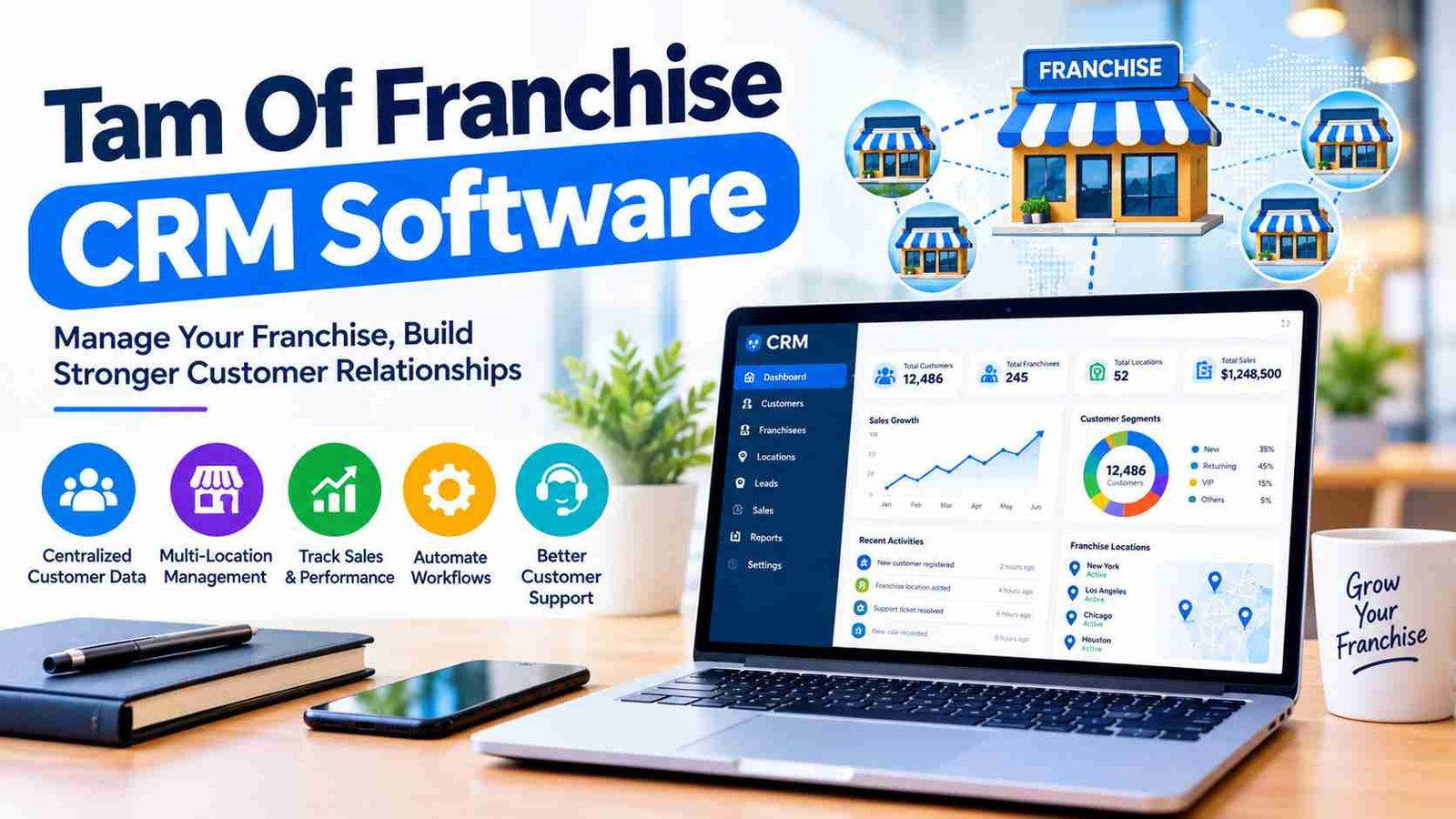
If you are researching what is the TAM of franchise CRM software, you are essentially trying to understand how large the total business opportunity is for customer relationship management platforms built for franchise organizations. Franchise CRM software helps franchisors and franchisees manage customer information, sales leads, marketing activities, communication, and performance across multiple locations. As franchise networks become more complex, having customer data in one organized system can make daily management easier and more efficient.
TAM stands for Total Addressable Market. It represents the maximum potential revenue opportunity available if a business could serve every suitable customer in its target market. TAM is useful for software companies, startup founders, investors, and franchise technology businesses because it helps them understand market potential before making major decisions.
However, there is no single universally accepted TAM number for franchise CRM software. Research companies use different definitions, customer segments, geographic areas, and calculation methods. Therefore, understanding how the market is measured is just as important as looking at the headline market-size figure.
What Is TAM in Franchise CRM Software?
What Does TAM Mean?
TAM, or Total Addressable Market, is the theoretical maximum market opportunity for a product or service. In simple terms, it answers the question: How much revenue could this market generate if every potential customer who needs the product purchased it?
For franchise CRM software, TAM includes organizations that could potentially use a CRM platform designed to support franchise operations and customer relationships. It does not mean that one company will actually capture the entire amount. Instead, it provides a broad picture of the market opportunity.
It is also important to separate TAM from current sales. A company might generate $1 million in annual revenue while operating in a market with a theoretical TAM of several billion dollars. The difference represents potential customers and revenue that are not currently being served by that company.
What Does Franchise CRM Software Include?
Franchise CRM software can cover several connected activities. These may include customer relationship management, franchise development leads, sales pipeline management, marketing automation, customer communication, reporting, and multi-location performance tracking.
Some platforms are focused mainly on customer relationships, while others combine CRM with wider franchise management features. This difference matters when calculating TAM because including broader franchise management functions can produce a larger market estimate.
Why Is TAM Important?
TAM helps software businesses understand whether a market is large enough to support their plans. It can influence product development, pricing, marketing budgets, sales strategies, investor discussions, and expansion decisions. A clearly defined TAM also helps a business avoid making broad claims about market size without explaining who the potential customers actually are.
What Is the Current TAM of Franchise CRM Software?
There is no single market figure that should automatically be treated as the definitive TAM. Current published research illustrates why.
For example, DataIntelo reports that the global franchise CRM software market was valued at $2.8 billion in 2025 and forecasts it to reach $7.1 billion by 2034, representing a projected CAGR of 10.9%. Its research divides the market by areas such as deployment mode, enterprise size, application, end user, and region.
Another 2026 report from WiseGuyReports estimates the market at $2.69 billion in 2025 and projects it to reach $5.2 billion by 2035, with a reported CAGR of 6.9%. It also segments the market by deployment type, functionality, end user, organization size, and geography.
| Published estimate | Base year | Forecast | Reported growth |
| DataIntelo | $2.8B in 2025 | $7.1B by 2034 | 10.9% CAGR |
| WiseGuyReports | $2.69B in 2025 | $5.2B by 2035 | 6.9% CAGR |
These differences do not necessarily mean one report is wrong. Market research firms can define the category differently, use different datasets, include different customer groups, or apply different forecasting methods. Verified Market Reports, for example, also lists a 2025 market estimate of $2.8 billion and a 2034 projection of $7.1 billion.For this reason, the most useful approach is to explain the source, year, market definition, and methodology whenever presenting a TAM figure.
How Is the TAM of Franchise CRM Software Calculated?
There are two common ways to estimate TAM: the top-down method and the bottom-up method.
Top-Down TAM Calculation
A top-down calculation begins with a large established market and gradually narrows it. For example, a researcher could begin with the broader CRM software market, identify the portion associated with franchise businesses, and then narrow that figure according to geography, business size, industry, and software functionality.
This approach can be useful when reliable industry-level market data is available. However, it depends heavily on the assumptions used to separate franchise CRM from general CRM and broader franchise management software.
Bottom-Up TAM Calculation
The bottom-up method starts with potential customers. A business estimates how many franchise organizations could purchase its software and how much each customer could spend annually.
The basic formula is:
TAM = Number of Potential Customers × Average Annual Revenue Per Customer
For example, suppose a hypothetical market contains 50,000 potential franchise businesses and the average annual CRM spending is $2,000. The calculation would be:
50,000 × $2,000 = $100 million
This $100 million is only an illustrative theoretical TAM, not an actual market statistic.
Location-Based and User-Based Calculations
Franchise CRM can also be priced according to locations or users. In that case, a more detailed calculation may consider the number of franchise brands, locations per brand, CRM users, and average subscription fees.
A business should choose the calculation method that best matches its actual pricing model. This makes the TAM more useful for planning instead of simply producing a large headline number.
What Factors Determine the TAM of Franchise CRM Software?
Several factors can increase or decrease the potential size of the franchise CRM market. The first is the number of franchise businesses and locations. A larger franchise network creates more potential users and more opportunities for CRM subscriptions.
The second factor is average software spending. A small franchise may choose a basic CRM plan, while a large international franchise network may require an enterprise platform with advanced analytics, integrations, automation, security, and support. Therefore, two customers can have very different annual contract values.
Industry mix also matters. Franchise businesses operate across food and beverage, retail, education, healthcare, fitness, hospitality, beauty, and professional services. Each sector can have different CRM requirements and technology budgets.
Geography is another important factor. A global TAM can include North America, Europe, Asia-Pacific, Latin America, and the Middle East and Africa. However, a company selling only in one region should not treat the entire global market as its immediately serviceable market.The research sources also show that franchise CRM markets are commonly segmented by deployment, organization size, functionality, end user, and region.
What Is Driving the Franchise CRM Software Market?
One major driver is the expansion of franchise networks. As businesses operate more locations, managing customer information through spreadsheets, disconnected applications, or manual processes becomes increasingly difficult. A centralized CRM can give franchisors and franchisees a shared view of customer activity and sales information.
The growing use of cloud-based software is another important factor. Cloud CRM platforms can be accessed from different locations and generally make it easier to add users, locations, and integrations. DataIntelo reports that cloud-based deployment represented 63.4% of the franchise CRM software market in 2025.
AI and automation are also changing what franchise CRM platforms can provide. Modern systems can support automated lead qualification, customer segmentation, predictive analysis, personalized marketing, and follow-up workflows. These capabilities can reduce repetitive work while giving franchise teams more useful customer insights.
Another driver is the need for better franchisor-franchisee communication. Franchise networks often have many independent locations operating under one brand. A centralized system can help organize communication, reporting, marketing activities, and performance information across those locations.
What Is the Difference Between TAM, SAM and SOM?
TAM is only one part of market analysis. SAM, or Serviceable Available Market, represents the part of TAM that a particular product can actually serve. Geography, product features, pricing, industry focus, and technical requirements can all reduce SAM.
SOM, or Serviceable Obtainable Market, is narrower. It represents the portion of SAM that a company could realistically reach based on its sales capacity, competition, resources, brand awareness, and distribution channels.
For example, imagine the global franchise CRM market is the TAM. A company may only sell to food, fitness, and retail franchises in selected English-speaking markets. That smaller group would represent its SAM. The customers it could realistically acquire using its current sales team and marketing budget would represent its SOM.Understanding these three terms prevents businesses from treating a large theoretical market as if it were immediately available to them.
| Market concept | Meaning | Franchise CRM example |
| TAM | Entire theoretical opportunity | All potential franchise CRM customers |
| SAM | Market the product can serve | Selected industries and regions |
| SOM | Market the business can realistically obtain | Customers reachable through current resources |
Who Uses Franchise CRM Software?
Franchise CRM software can serve several types of users. Franchisors may use it to manage franchise development leads, communicate with franchisees, monitor network performance, and coordinate brand-wide marketing.
Franchisees can use CRM tools for local customer management, lead tracking, marketing campaigns, and customer retention. For operators managing several locations, centralized CRM data can make it easier to compare performance and maintain consistent processes.
Franchise marketing teams are another important customer group. They may use CRM systems to segment customers, organize campaigns, nurture leads, and manage communication across multiple locations.
This broad customer base contributes to the potential TAM, but it also makes market sizing more complicated. A CRM designed for a small single-unit franchise may have a very different price and feature set from a platform used by a large multi-unit franchise organization.
Franchise CRM TAM vs. Broader Franchise Management Software TAM
Franchise CRM software should not automatically be treated as the same market as franchise management software. A CRM may focus primarily on customers, leads, sales, communication, and marketing. A broader franchise management platform can include CRM alongside operations, compliance, training, royalty management, document management, field support, and performance management.
This distinction is important when comparing market research reports. A report that includes a wide range of franchise management functions may produce a larger market estimate than research focused specifically on CRM.
For businesses calculating their own TAM, the best approach is to define exactly what the product includes before estimating the market. If a platform provides customer management and franchise operations in one product, the company should explain which revenue opportunities are included in its TAM calculation.Clear definitions make the analysis easier for investors, business partners, and internal teams to understand.
How Can a Business Estimate Its Own Franchise CRM TAM?
A practical TAM study starts by defining the ideal customer profile. Consider the franchise’s industry, size, location, number of units, technology needs, and likely software budget.Next, estimate the number of potential customers. Industry directories, franchise associations, business databases, company websites, and public business information can help build a reasonable customer universe.
The next step is determining average annual contract value. This could include monthly or annual subscriptions, per-user charges, per-location pricing, enterprise plans, implementation fees, or premium support.Once these figures are available, multiply the number of suitable customers by the expected annual revenue per customer. The result provides a bottom-up TAM estimate.
After that, narrow the market to calculate SAM and SOM. Remove customers outside the product’s geographic coverage, pricing range, technical capabilities, or target industries. Then consider the company’s actual sales resources and competitive position when estimating the obtainable market.This approach creates a transparent TAM model based on assumptions that can be reviewed and updated as the business grows.
FAQ’s
1. What is the #1 CRM in the world?
Salesforce is widely recognized as one of the world’s leading CRM platforms, with a large global customer base and a broad range of CRM tools.
2. Will CRM be replaced by AI?
No. AI is more likely to improve CRM than replace it. AI can automate tasks, analyze customer data, and provide recommendations while CRM remains the system that organizes customer information.
3. What are the top 3 franchises?
The answer depends on the industry and ranking criteria. Major global franchise brands include McDonald’s, Subway, and KFC, among many others.
4. What is the #1 CRM platform?
Salesforce is commonly considered a leading CRM platform because it offers sales, marketing, customer service, analytics, and automation tools.
5. What are the top 3 CRM systems?
Three widely used CRM systems are Salesforce, Microsoft Dynamics 365, and HubSpot CRM. Each offers different features and pricing options.
6. Why is Salesforce falling?
Salesforce has faced concerns about slower growth, strong competition, changing customer spending, and the need to adapt quickly to AI-powered technology. These factors can affect investor sentiment and market performance.
7. Who is Salesforce’s biggest competitor?
Microsoft Dynamics 365 is one of Salesforce’s major competitors. Other important competitors include HubSpot, Oracle, SAP, and Zoho.
8. Does Salesforce have any future?
Yes. Salesforce continues to invest in CRM, artificial intelligence, automation, data management, and cloud services. Its future will depend partly on how successfully it adapts to changing customer and AI technology needs.
9. What is the problem with Salesforce?
Common concerns include its relatively high cost, complexity, customization requirements, and the learning curve for new users. Some businesses may also find that they need additional tools or expertise to manage large Salesforce implementations.
Conclusion
Understanding what is the TAM of franchise CRM software requires more than finding one large market-size number. TAM represents the theoretical revenue opportunity, while SAM and SOM provide increasingly narrower views of the market a specific business can serve and realistically capture. Current published research places the global franchise CRM software market in the multi-billion-dollar range, but estimates differ because researchers use different definitions and methodologies.
For a reliable business analysis, define the market clearly, identify potential customers, estimate annual software spending, and explain every assumption. This approach provides a more useful picture of franchise CRM opportunity than relying on a single headline figure.