Introduction
Starting a digital business can be an attractive option for entrepreneurs who want to sell products without managing physical inventory. A software key reselling business allows you to offer software licenses, subscriptions, and related services to individuals or organizations through online channels. However, success depends on more than finding cheap keys and selling them at a higher price.
If you are researching how to start a software key reselling business, the most important steps are choosing the right market, finding legitimate suppliers, understanding licensing rules, building customer trust, and creating a reliable sales process. A key that activates is not automatically proof that it was legally sourced or that it can be resold.
This guide explains how the business works, which products you can consider, how to evaluate suppliers, what legal and financial issues matter, and how to build a store that customers can trust. Whether you want to begin with a small catalog or eventually serve business clients, a careful and transparent approach will give you a stronger foundation.
What Is a Software Key Reselling Business?
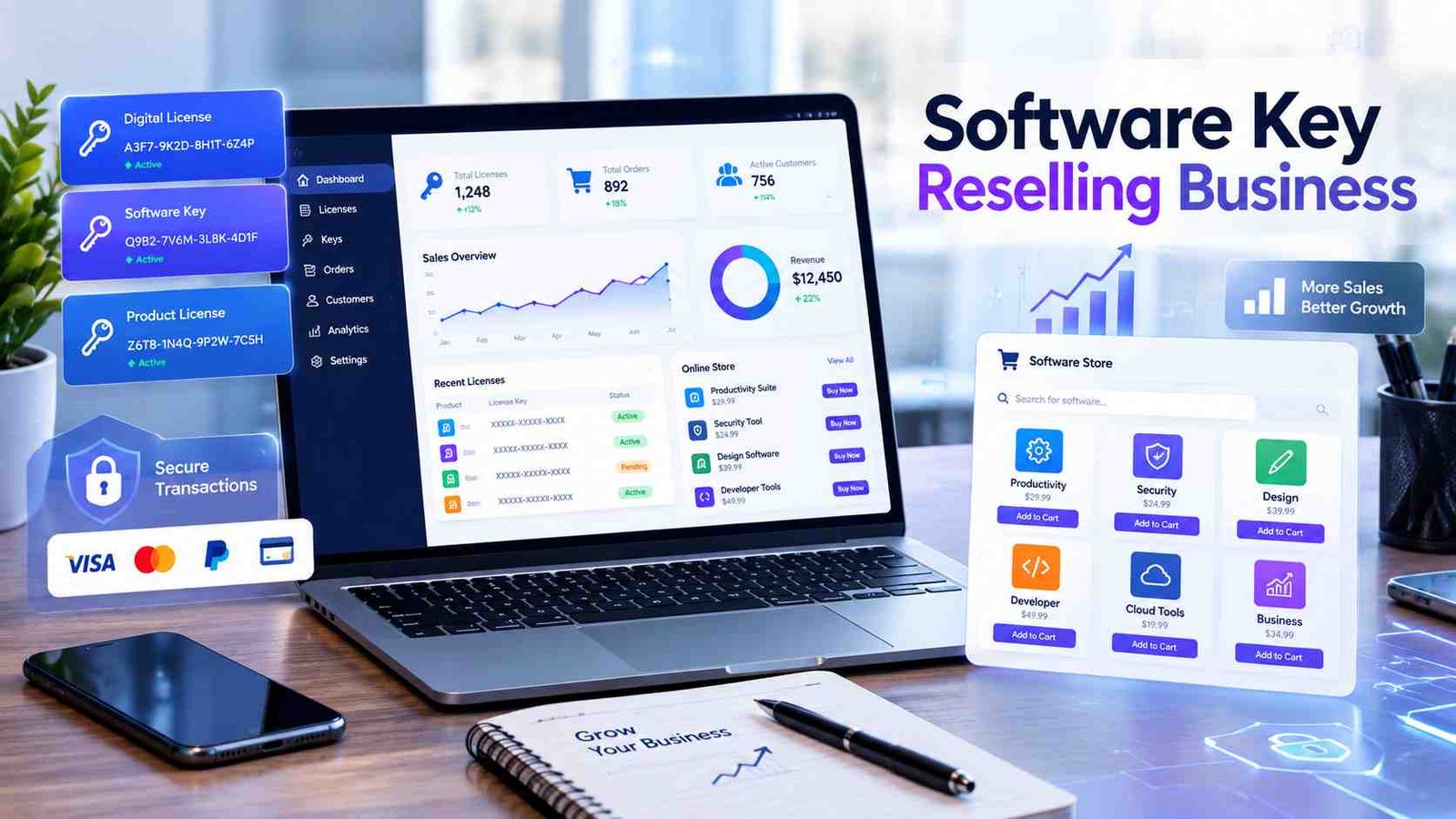
A software key reselling business involves obtaining software licenses or subscriptions through an authorized vendor, distributor, or partner program and selling them to eligible customers. Depending on the agreement, the reseller may earn money through a markup, commission, recurring subscription revenue, or additional services.
The basic process is straightforward. First, you identify a supplier that has the right to distribute the software. Next, you purchase or refer licenses under the supplier’s terms. You then promote the products through a website, marketplace, social media, or direct business outreach. After receiving an order, you deliver the license through an approved method and help the customer understand activation, installation, or renewal requirements.
You may be able to resell several types of software, including productivity applications, security tools, accounting platforms, design programs, developer tools, and cloud subscriptions. However, the exact products you can offer depend on the supplier’s authorization and the software’s license terms.
The key principle is simple: you are selling a license or subscription right, not merely a string of characters. Customers need to know what they are purchasing, how long it lasts, how many devices or users it covers, and what restrictions apply.
Is Software Key Reselling a Profitable Business?
Software key reselling can be profitable, but profitability is not guaranteed. Your results depend on the difference between your selling price and your total business costs. These costs may include the supplier’s price, payment processing fees, taxes, advertising, refunds, replacements, customer support, and website expenses.A simple way to understand the calculation is:
Profit per sale = Selling price − Product cost − Payment fees − Taxes − Other variable costs
For example, a product may appear to offer a large markup, but frequent refunds, expensive advertising, or supplier problems can reduce the actual profit. This is why choosing products only because they are cheap is a weak business strategy.
One advantage of this model is that digital products do not usually require traditional warehousing or shipping. You may also reach customers in different regions and create repeat revenue through software subscriptions and renewals. Business customers can provide additional opportunities because they may need multiple licenses, account management, or ongoing support.
However, competition can be strong, especially for popular software products. Established sellers may already have better supplier relationships, stronger search visibility, and trusted customer reviews.
The most sustainable approach is to focus on legitimate products, clear pricing, dependable support, and repeat customers rather than promising unrealistic discounts. A smaller business with satisfied customers can be stronger than a store that makes quick sales but regularly faces activation complaints.
Choose Your Software Reselling Business Model
Before investing money, decide how you want to operate. Not every software reseller needs to purchase inventory or manage license delivery directly. Your business model affects your startup costs, responsibilities and potential earnings.
Direct Software License Reselling
In direct reselling, you obtain authorized licenses and sell them to end users. You may manage product listings, payments, delivery, and customer support. This model gives you more control over the customer experience, but it also creates more responsibility. You must understand the supplier agreement and ensure that your sales follow the permitted terms.
Affiliate or Referral Reselling
An affiliate or referral model allows you to promote a vendor’s software and earn a commission when customers purchase through your referral. The vendor may handle payment, activation, delivery, and support. This approach can be easier for beginners because it usually requires less operational infrastructure, although you have less control over pricing and customer ownership.
Value-Added Reselling
Value-added resellers combine software with services such as installation, setup, training, migration, consulting, or technical support. This model can be attractive to business customers who want a complete solution instead of purchasing a license alone.
Subscription and SaaS Reselling
Subscription reselling involves offering recurring software plans through an approved partner program. The business may earn revenue from new subscriptions and renewals. Before choosing this model, understand who handles billing, cancellations, renewals, customer data, and technical support.
| Business Model | Main Customers | Main Responsibility |
| Direct reselling | Individuals and businesses | Sourcing, selling, and supporting licenses |
| Affiliate/referral | Consumers and businesses | Marketing and customer referrals |
| Value-added reselling | Small and large businesses | Software plus services and support |
| SaaS subscription reselling | Businesses and teams | Subscription management and renewals |
Research the Market and Choose a Niche
A common beginner mistake is trying to sell every type of software at once. A focused niche is usually easier to manage because you can understand the products, identify customer needs, create useful content, and build stronger supplier relationships.
Start by researching what your target customers actually need. Individual buyers may want affordable productivity or security software, while businesses may need accounting platforms, collaboration tools, design applications, or software for managing employees. Compare demand, competition, pricing, support requirements, and supplier availability before choosing a category.
For example, you could focus on software for small businesses, cybersecurity products, productivity tools for professionals, design applications for freelancers, or industry-specific business software. The best niche is not necessarily the one with the lowest prices. It is the one where you can offer legitimate products and provide useful guidance.
When evaluating a product, consider its vendor reputation, licensing terms, regional availability, activation process, renewal opportunities, and refund policy. A product with slightly lower margins but reliable support may be safer than one with a large markup and frequent customer complaints.
You should also decide whether you want to serve consumers or businesses. B2C sales may involve more individual orders and price comparisons. B2B sales may require contracts, invoices, volume licensing, account management, and longer sales cycles. Choosing one primary audience helps you create a clearer business plan.
Understand Software License Types Before Selling
Understanding license types is essential because different licenses can have different usage, transfer, support, and resale conditions. Misrepresenting a license can lead to customer complaints, account problems, or legal disputes.
Retail licenses are generally designed for individual customers and may include specific rules about installation, transfers, and supported devices. OEM licenses are often associated with particular hardware or manufacturers and may have restrictions that differ from retail products. You should never describe an OEM license as a standard retail license unless the vendor explicitly permits that description.
Volume licenses are designed for organizations that need software for multiple users or devices. They may be managed through an organization’s licensing system rather than delivered as ordinary individual keys. Selling volume licenses as separate consumer products without authorization can create serious problems.
There is also a major difference between perpetual and subscription licenses. A perpetual license may allow continued use under its terms, while a subscription generally requires recurring payment and may stop working or lose access to certain features after expiration.
Before listing a product, confirm the number of permitted users or devices, activation limits, geographic restrictions, transfer rights, commercial-use permissions, renewal conditions, and vendor support eligibility. Explain these details clearly on your product page. Customers should understand exactly what they are buying before they pay.
Find Legitimate Software Key Suppliers
Finding reliable suppliers is one of the most important steps in learning how to start a software key reselling business. Your supplier affects product authenticity, pricing, delivery speed, customer satisfaction, and the long-term safety of your business.
Begin with official software vendor partner programs, authorized distributors, established B2B technology suppliers, and legitimate affiliate networks. Many vendors have reseller, partner, or referral pages where businesses can apply or request information. If authorization is unclear, contact the vendor directly rather than relying only on a supplier’s claims.
Before placing a large order, ask the supplier whether it has the right to distribute the products and whether resale is permitted in your target market. Request invoices, licensing documentation, and clear information about replacement procedures. You should also understand whether the supplier provides a portal, automated delivery system, or approved API.
Be cautious of suppliers offering extremely low prices without explaining the reason. A low price may sometimes be legitimate, but it can also indicate regional restrictions, unusual license conditions, unauthorized sourcing, or products that are not intended for resale.A good supplier should be able to explain what it sells and how it handles failed activations. Important questions include:
- Are you authorized to distribute these licenses?
- What license types are available?
- Are the products valid in my target region?
- Can you provide invoices and proof of purchase?
- What happens if a key fails activation?
- What are the refund and replacement terms?
- Are there minimum purchase requirements?
Never assume that a supplier is trustworthy simply because its website looks professional.
Verify Authenticity and Licensing Rights
A software key that activates successfully is not always proof that it was lawfully obtained. Some keys may be stolen, leaked, fraudulently purchased, region-restricted, or distributed in ways that violate the vendor’s terms. If a vendor later blocks a questionable license, your customer may hold your business responsible.
For this reason, verify the supplier’s identity, distribution rights, purchase records, and licensing conditions before selling. Keep invoices and supplier communications organized so you can demonstrate where your products came from. Also confirm that the license matches the customer’s intended use.
Avoid advertising terms such as “official,” “genuine,” or “lifetime” unless you can support those claims. A subscription should not be presented as a permanent license, and a restricted license should not be marketed as unrestricted.
Common warning signs include a supplier that refuses to provide invoices, cannot explain license origin, hides regional restrictions, has frequent activation failures, or pressures you to purchase a large quantity immediately. You should also be careful if the supplier’s prices are far below normal market rates with no clear explanation.
Building your business around questionable keys may create short-term sales, but it can damage your reputation, increase refunds, and expose you to legal and financial risks. Legitimate sourcing is not just a legal concern; it is a core part of customer service.
Create a Business Plan and Handle Legal Requirements
Once you understand your market and suppliers, create a simple business plan. Define your target customers, initial product catalog, sales channels, startup budget, pricing approach, and customer support process. Estimate costs for your website, domain, hosting, supplier purchases, payment processing, marketing, accounting, and security.
Your legal responsibilities depend on your country, business structure, products, and target customers. You may need to register your business, understand tax obligations, follow consumer protection rules, and comply with privacy requirements. If you sell internationally, additional rules may apply to digital products, VAT, sales tax, payments, and cross-border transactions.
You should also review the software reseller agreement carefully. Look for territory restrictions, minimum sales requirements, pricing rules, marketing permissions, support obligations, refund policies, and termination conditions. The agreement should clearly explain what you are allowed to sell and how you may sell it.
Do not assume that purchasing a license automatically gives you resale rights. Some licenses are intended only for end users, while others may be distributed through specific partner channels. If the terms are unclear, ask the vendor or consult a qualified legal professional familiar with software licensing.
Keeping accurate business records is equally important. Save supplier invoices, customer orders, refunds, and tax information. A properly organized business is easier to manage and more prepared to resolve disputes.
Set Up Your Online Store and Secure Delivery
Your store should make purchasing software simple and transparent. Choose a suitable e-commerce platform or build a custom website, then organize products into clear categories. Each product page should explain the software edition, license type, duration, supported systems, user or device limits, delivery method, activation instructions, and restrictions.
Include essential pages such as About Us, Contact, FAQs, Refund and Replacement Policy, Terms and Conditions, Privacy Policy, and License Information. These pages help customers understand your business and can improve trust.
For payments, use a reputable processor that supports your business type and target market. Enable fraud-prevention tools and avoid storing sensitive payment information unnecessarily. License details should be delivered only after payment has been verified.
Manual delivery may be suitable when you have a small number of orders. It allows you to review each transaction and provide personal support, but it requires careful record-keeping. Automated delivery can save time as sales increase, especially when connected to an approved supplier portal or API. However, automation must be tested carefully to prevent incorrect or duplicate deliveries.
Before launching, place test orders, check confirmation emails, verify delivery timing, and make sure customers receive accurate instructions. A smooth buying process can reduce support requests and improve customer satisfaction.
Create Pricing and Marketing Strategies
Your pricing should cover the complete cost of selling a product, not just the supplier’s price. Include payment fees, taxes, refunds, support time, advertising, and other variable expenses. Research competitor prices, but do not compete only by offering the cheapest deal. Extremely low prices can make customers question product legitimacy.
For marketing, focus on trust and useful information. Create product comparison pages, software buying guides, compatibility articles, license explanations, and activation help content. These resources can attract search traffic while helping customers make informed decisions.
Use the main keyword “how to start a software key reselling business” in relevant educational content, but avoid repeating it unnaturally. Your product pages should focus on specific software names and customer questions. Add internal links between related guides, product pages, and FAQs.
You can also reach customers through social media, email marketing where permitted, partnerships with computer shops, IT consultants, freelancers and small businesses. B2B customers may respond well to volume pricing, account support, and software management services.The strongest marketing message is not simply “cheap keys.” It is a clear promise of legitimate products, transparent license terms, reliable delivery and responsive support.
Provide Support and Track Business Performance
Customer support is especially important in software reselling because activation and compatibility issues can be confusing. Provide clear instructions and explain what customers should do if a key does not work. When a problem occurs, investigate it before issuing a replacement or refund, and follow the supplier’s policies.
Common issues include missing delivery emails, incorrect email addresses, activation failures, unsupported operating systems, expired subscriptions, and device limits. A helpful support process can turn a difficult experience into a positive one.
At the same time, track your business performance. Record supplier costs, customer orders, delivery status, refunds, replacements, and product profitability. Monitor metrics such as total sales, net profit, refund rate, repeat purchase rate, renewal rate, and customer acquisition cost.
These numbers help you identify which products are worth continuing and which ones create too many problems. As your business grows, you can use accounting software, customer relationship tools, and license-management systems to reduce manual work.
Frequently Asked Questions
1. Can I start a software key reselling business from home?
Yes, you can often begin from home because software is delivered digitally. However, you still need legitimate suppliers, a suitable sales process, customer support, and compliance with applicable business and licensing rules.
2. What is the biggest risk in software key reselling?
One of the biggest risks is selling improperly sourced or unauthorized licenses. These products may later fail activation or create legal and financial problems. Supplier verification is essential.
3. Should beginners sell many software products?
It is usually better to start with a small catalog. Choose products you understand, verify their licensing terms and expand only after you have a reliable fulfillment and support process.
4. Can software resellers earn recurring income?
Yes. Approved subscription and SaaS reseller programs may provide recurring revenue through renewals. The exact payment structure depends on the vendor agreement and customer retention.
5. What makes customers trust a software key store?
Clear license information, legitimate sourcing, transparent policies, secure payments, accurate delivery, responsive support and honest advertising are major factors that build trust.
Conclusion
Learning how to start a software key reselling business requires more than finding software at a low price. You need to choose a clear niche, understand license types, work with legitimate suppliers, and follow the rules that govern software distribution. A professional store, secure delivery process, fair pricing, and helpful customer support will also improve your chances of long-term success.
Start with a small product catalog and maintain accurate records of every purchase and sale. Focus on products you can verify and support rather than chasing unrealistic discounts. When customers receive legitimate software and honest service, your business can build repeat sales, stronger relationships and a reliable foundation for growth.