Introduction
Running a successful bicycle rental business is much easier with the right digital tools. Bike rental software is a specialized system that helps businesses manage online bookings, bike availability, customer information, payments, and maintenance from one platform. Whether you rent traditional bicycles, electric bikes, mountain bikes, or city bikes, this software simplifies daily operations and improves the customer experience.
Many rental businesses still rely on paper calendars, spreadsheets, or phone reservations. While these methods may work for a small fleet, they often lead to double bookings, scheduling mistakes, lost customer records, and unnecessary administrative work. Modern customers also expect to reserve bikes online and receive instant confirmations on their mobile devices.
This complete guide explains everything you need to know about bike rental software. You will learn how it works, its most important features, different software types, pricing models, and how to choose the best solution for your business. Whether you own a small bike shop or manage a large multi-location rental company, this article will help you make an informed decision.
What Is Bike Rental Software?
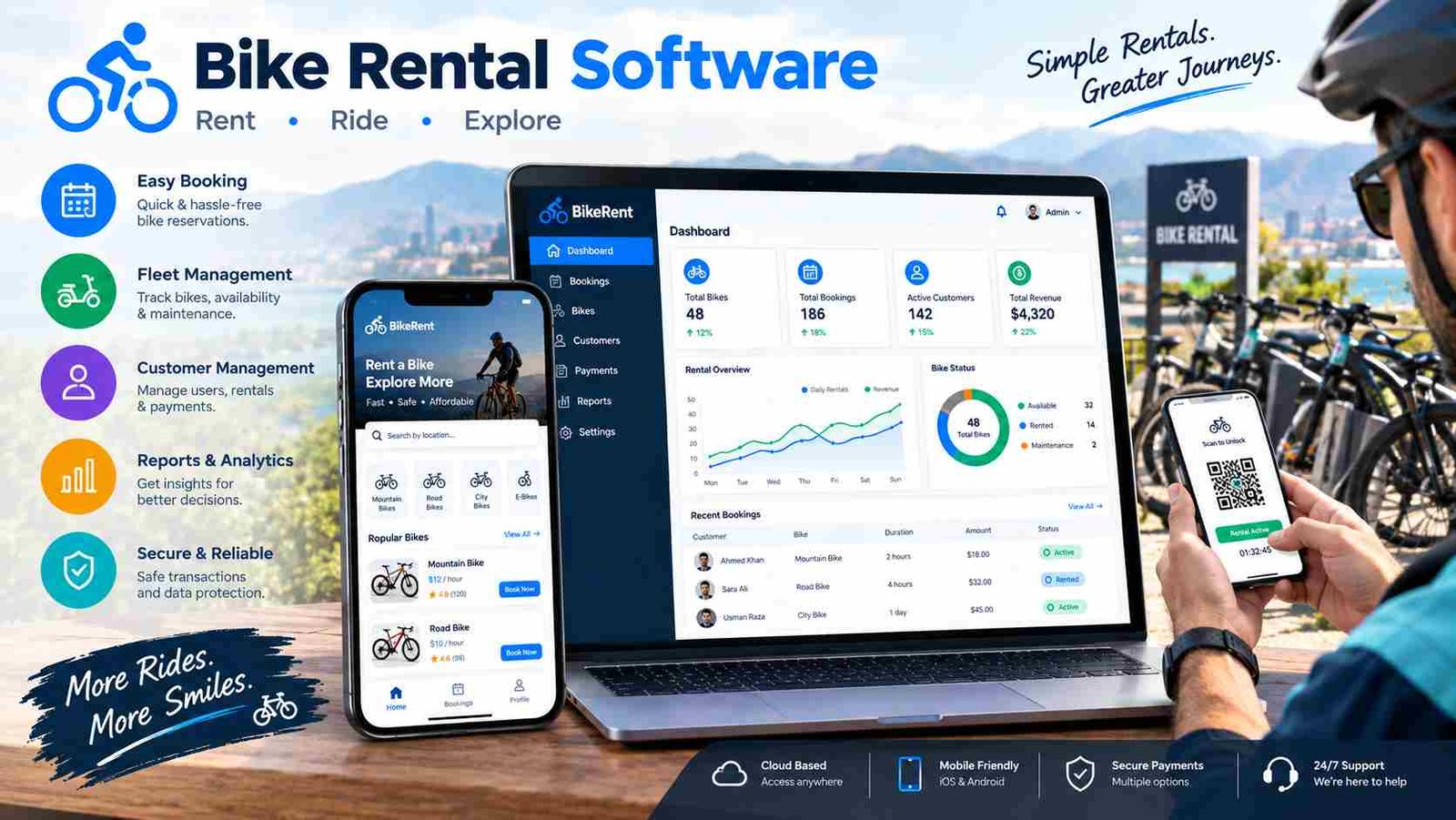
Bike rental software is a digital management platform designed specifically for bicycle and e-bike rental businesses. It automates the entire rental process, from accepting online reservations to tracking inventory, processing payments, managing customer records, and scheduling maintenance.
Unlike generic appointment or booking software, bike rental software is built around physical rental equipment. It knows which bikes are available, which are reserved, and which require repairs. This real-time fleet management prevents overbooking while helping staff assign the correct bike size and model to every customer.
The software is used by many types of organizations. Independent bike rental shops use it to increase online bookings and reduce manual paperwork. E-bike rental companies depend on it for battery and fleet management. Tour operators schedule guided cycling tours, while hotels and resorts offer bicycles as an additional guest service. Universities and corporate campuses also use bike rental systems to support sustainable transportation programs.
The biggest advantage is automation. Instead of managing multiple spreadsheets, phone calls, and paper contracts, businesses can operate from a single dashboard that provides complete visibility into rentals, inventory, revenue, and customer activity.
How Bike Rental Software Works?
A modern bike rental system creates a smooth journey for both customers and staff. Every stage of the rental process is connected automatically, reducing delays and improving accuracy.
Online Reservation
The customer begins by visiting the rental website or mobile booking page. They choose the rental date, pickup time, return time, and preferred bike category. The system instantly displays real-time availability, ensuring only available bikes can be reserved. Once the booking is confirmed, the customer receives an automatic email or SMS confirmation.
Bike Assignment
After the reservation is made, staff can assign the most suitable bicycle based on size, model, or rental category. Premium systems even allocate individual bike IDs, making inventory tracking much more accurate for larger fleets.
Payment & Security Deposit
Customers can securely pay online using credit cards, digital wallets, or other supported payment methods. Many businesses also collect a refundable security deposit, and the software automatically generates digital invoices and payment receipts.
Pickup & Digital Waiver
During pickup, customers scan a QR code or provide their booking number. They sign a digital liability waiver electronically, eliminating paper contracts and speeding up the check-in process.
Return & Inspection
When the bike is returned, staff record its condition, note any damages, and close the rental. If maintenance is required, the bike is automatically moved into the service queue before becoming available again.
Key Features Every Bike Rental Software Should Have
The value of bike rental software depends on its features. A complete system should improve both customer convenience and operational efficiency.
An online booking system allows customers to reserve bikes 24/7 from any device. Mobile-friendly booking pages, instant confirmations, and automated reminders reduce missed appointments while increasing reservations outside business hours.
Real-time fleet management gives staff a live overview of every bicycle. Managers can instantly see which bikes are available, reserved, currently rented, or undergoing maintenance. This visibility helps maximize fleet utilization and prevents scheduling conflicts.
Inventory tracking is another essential feature. Each bicycle receives a unique identification number along with details such as frame size, model, color, accessories, and maintenance history. Helmets, locks, child seats, and other rental accessories can also be managed within the same inventory.
Flexible pricing allows businesses to create hourly, half-day, daily, weekly, and seasonal rental rates. Dynamic pricing can also support holiday promotions or off-season discounts without manual calculations.
Integrated payment gateways simplify secure online transactions through credit cards, Stripe, PayPal, and regional payment providers. Digital waivers and electronic contracts eliminate paperwork while storing signed documents safely in the cloud.
Customer relationship management helps businesses retain loyal customers by storing rental history, contact information, and loyalty rewards. Finally, reporting and analytics provide valuable insights into revenue, utilization rates, popular bike models, and peak rental seasons.
Types of Bike Rental Software
Different rental businesses have different operational needs, so bike rental software is available in several specialized categories.Bicycle rental shop software is ideal for traditional rental stores with a physical location. It focuses on inventory management, walk-in rentals, online reservations, and payment processing. Small and medium-sized bike shops often choose this type because it balances affordability with essential features.
E-bike rental software includes additional tools for managing electric bicycles. Operators can track battery status, charging schedules, and maintenance records while organizing larger fleets of electric bikes used in tourist cities or urban mobility programs.
Mountain bike rental software is designed for adventure businesses located near trails and outdoor destinations. It often supports equipment bundles, allowing customers to rent protective gear, helmets, GPS devices, and repair kits together with the bike.
Bike tour booking software serves guided tour companies by combining rental management with tour scheduling. Businesses can manage tour guides, group sizes, departure times, and participant lists while assigning bicycles to every rider.
Self-service bike sharing software supports docked and dockless bike-sharing systems. Customers unlock bicycles through mobile apps or QR codes, making it suitable for universities, municipalities, and large corporate campuses that provide automated bicycle access without constant staff supervision.Choosing the correct type depends on your business model, fleet size, customer volume, and whether you operate from one location or multiple branches.
Who Should Use Bike Rental Software?
Bike rental software is valuable for almost any organization that lends bicycles to customers or members. Independent bike rental shops use it to manage reservations efficiently while reducing paperwork and improving customer service. Even businesses with fewer than twenty bikes benefit from automated scheduling and digital payments.
Tourist destinations, beaches, national parks, and waterfront attractions often experience seasonal demand. A digital booking system allows visitors to reserve bikes before arriving, reducing queues during busy holidays. Hotels and resorts also use rental software to offer bicycles as a premium guest amenity, creating an additional source of revenue without increasing administrative work.
Adventure tour operators rely on software to organize guided cycling experiences. Instead of managing separate booking calendars and participant lists, they can coordinate guides, equipment, and customer information within one platform.
Universities and corporate campuses increasingly promote cycling as sustainable transportation. Self-service rental software helps students and employees borrow bikes securely while tracking usage automatically.
City bike-sharing programs operate much larger fleets and require GPS tracking, mobile applications, and automated unlocking systems. Regardless of business size, organizations that want better inventory control, higher customer satisfaction, and improved operational efficiency can benefit from adopting bike rental software.
Benefits of Using Bike Rental Software
The greatest advantage of bike rental software is its ability to replace repetitive manual tasks with automated workflows. This improves both customer satisfaction and overall business profitability.
One major benefit is preventing double bookings. Because inventory updates in real time, two customers cannot reserve the same bicycle for identical time slots. This protects the business from scheduling errors and disappointed customers.
Automation also saves significant staff time. Employees no longer need to answer every booking by phone, update spreadsheets manually, or prepare paper contracts. Instead, reservations, invoices, reminders, and receipts are generated automatically.
Online booking availability increases revenue because customers can reserve bikes anytime, even outside business hours. Businesses are no longer limited by staff availability or office opening times.
Fleet utilization improves through better visibility. Managers can identify underused bicycles, schedule maintenance proactively, and ensure popular models remain available during peak demand.
Customer experience also becomes much smoother. Fast QR check-in, digital waivers, secure payments, and instant confirmations create a professional rental process that encourages repeat business.
Finally, businesses can increase revenue through optional add-ons such as helmets, child seats, guided tours, insurance, and repair kits. Because these extras appear during online checkout, customers are more likely to include them in their reservation, increasing the average rental value.
Essential Modules Inside a Bike Rental Management System
A complete bike rental software platform contains several connected modules that work together. Each module supports a different part of the rental business while sharing information through one centralized database.
| Module | Purpose |
| Booking Engine | Online reservations and availability |
| Fleet Dashboard | Live bike status and assignments |
| Inventory Manager | Bikes, sizes, accessories, and IDs |
| Payment System | Billing, deposits, and invoices |
| CRM | Customer profiles and rental history |
| Maintenance Module | Service schedules and repair records |
| Reporting | Revenue, utilization, and business analytics |
These integrated modules eliminate duplicate data entry while giving managers complete visibility across operations.
Bike Rental Software vs Manual Rental Management
The difference between digital and manual management becomes clear as businesses grow. Software improves accuracy, speed, and customer convenience.
| Feature | Manual System | Bike Rental Software |
| Booking | Phone or paper | Online reservations |
| Availability | Manual updates | Real-time tracking |
| Payments | Cash only | Digital & online |
| Contracts | Paper forms | Electronic waivers |
| Maintenance | Notebook records | Automated reminders |
| Reports | Spreadsheets | Interactive dashboard |
For growing rental businesses, digital management reduces errors while providing better visibility into daily operations.
How to Choose the Best Bike Rental Software?
Choosing the right platform starts with understanding your business requirements rather than simply selecting the most feature-rich product.
Fleet size is an important consideration. Businesses with fewer than twenty bikes usually need affordable software with online booking and payment features. Medium-sized fleets benefit from inventory tracking and maintenance scheduling, while large operations often require multi-location management, staff permissions, and advanced analytics.
Your business model also matters. Hourly rentals require flexible pricing and quick check-in, while guided tour operators need participant management and scheduling tools. Multi-location businesses should prioritize centralized inventory and branch-specific availability.
Integration capabilities are equally important. The software should connect smoothly with your website, payment gateways, accounting software, and point-of-sale system. These integrations reduce manual data entry and improve financial reporting.
Cloud-based solutions are generally the preferred choice because they provide automatic updates, secure data backup, remote access, and lower IT maintenance costs. On-premise systems may suit organizations with strict internal infrastructure requirements, but they usually require greater technical support and higher setup expenses.
Best Bike Rental Software Solutions
Several well-known platforms serve different types of rental businesses. Rather than declaring one winner, it is more useful to compare their strengths and ideal use cases.
| Software | Best For | Key Features |
| Booqable | Small rental businesses | Inventory & online bookings |
| Bike.rent Manager | Bike shops | Fleet management & scheduling |
| Valet | Tour operators | QR check-in & digital waivers |
| Joyride | Bike sharing | Mobile app & GPS tracking |
| Rent2B | Multi-location rentals | Pricing & inventory control |
Booqable is a strong choice for smaller rental businesses because it combines inventory management, online reservations, and payment processing within an easy-to-use interface.
Bike.rent Manager focuses on bicycle shops that need detailed fleet management, maintenance records, and efficient customer scheduling for daily rentals.Valet is designed for guided cycling tours and businesses that want fast QR-based pickup, digital waivers, and organized participant management.
Joyride supports large bike-sharing operations through mobile applications, GPS tracking, smart locking technology, and automated customer access.Rent2B works well for companies operating multiple rental locations by providing centralized inventory, flexible pricing, and comprehensive reporting across branches.
Pricing of Bike Rental Software
The cost of bike rental software depends more on business needs than on a single fixed price. Most providers offer several pricing models to support different company sizes.Free plans are suitable for startups testing online reservations with a limited fleet. These versions often include basic booking functionality but restrict users, locations, or advanced reporting.
Monthly subscription plans are the most common option. Businesses pay a recurring fee that usually includes cloud hosting, software updates, customer support, and feature improvements. This predictable model makes budgeting easier for small and medium-sized businesses.Commission-based pricing charges businesses a percentage of each completed booking instead of a fixed monthly fee. This model may appeal to seasonal operators with fluctuating demand because costs rise only when revenue increases.
Enterprise solutions are designed for municipalities, universities, and large bike-sharing networks. They typically include custom integrations, advanced security, dedicated support, and scalable infrastructure.
Several factors influence pricing, including fleet size, number of staff users, business locations, integrations with external software, reporting features, and customer management tools. Before choosing a plan, businesses should evaluate long-term scalability rather than focusing only on the lowest monthly cost.
Common Challenges and Their Solutions
Every rental business faces operational challenges, but modern software provides practical solutions that improve efficiency and customer satisfaction.
| Problem | Software Solution |
| Double bookings | Live availability updates |
| Lost bikes | Inventory & ID tracking |
| Paper waivers | Digital forms |
| Missed maintenance | Automatic service reminders |
| Slow checkout | QR code pickup |
| Revenue tracking | Analytics dashboard |
By automating these processes, businesses reduce human error while delivering a faster and more professional rental experience.
Future Trends in Bike Rental Software
The future of bike rental software is becoming increasingly intelligent, connected, and customer-focused. Artificial intelligence is beginning to support dynamic pricing by adjusting rental rates based on demand, weather, holidays, and seasonal trends.
Predictive maintenance uses historical service data to identify bicycles that may require repairs before breakdowns occur. This reduces unexpected downtime and extends the lifespan of expensive rental fleets.
IoT smart locks are transforming self-service rentals by allowing customers to unlock bicycles directly from mobile apps without staff assistance. Combined with GPS fleet tracking, operators gain better visibility into bike locations and theft prevention.
Mobile-first customer experiences continue to grow through digital wallets, instant notifications, and contactless check-in. Customers increasingly expect the entire rental process—from reservation to return—to happen on their smartphones.
Sustainability reporting is another emerging trend. Businesses can measure bicycle usage, carbon savings, and environmental impact, making rental programs more attractive to universities, cities, and eco-conscious travelers looking for greener transportation options.
Frequently Asked Questions
1. What is bike rental software?
Bike rental software is a digital platform that manages online bookings, bike inventory, customer records, payments, maintenance, and rental agreements in one system.
2. Is bike rental software suitable for small businesses?
Yes. Small rental shops can use affordable cloud-based solutions to automate reservations, reduce paperwork, and improve customer service without needing a large team.
3. Can customers book bikes online?
Absolutely. Most modern bike rental software includes a 24/7 online booking system where customers can check availability, choose bikes, pay securely, and receive instant confirmation.
4. Does bike rental software support e-bikes?
Yes. Many platforms include e-bike management features such as battery tracking, charging schedules, maintenance records, and specialized inventory control.
5. Can bike rental software manage multiple locations?
Yes. Multi-location systems allow businesses to manage separate branches, transfer inventory, monitor availability, and generate reports from one centralized dashboard.
Conclusion
Bike rental businesses need more than a simple booking calendar to operate efficiently. Bike rental software brings reservations, fleet management, payments, customer records, maintenance, and reporting together in one easy-to-use platform. It reduces manual work, prevents scheduling mistakes, and creates a smoother experience for both customers and staff.
When choosing a solution, consider your fleet size, business model, required integrations, and future growth plans. A scalable cloud-based system will help your business adapt as demand increases while improving operational efficiency. Investing in the right bike rental software is an important step toward building a modern, profitable, and customer-friendly bicycle rental business.