Introduction
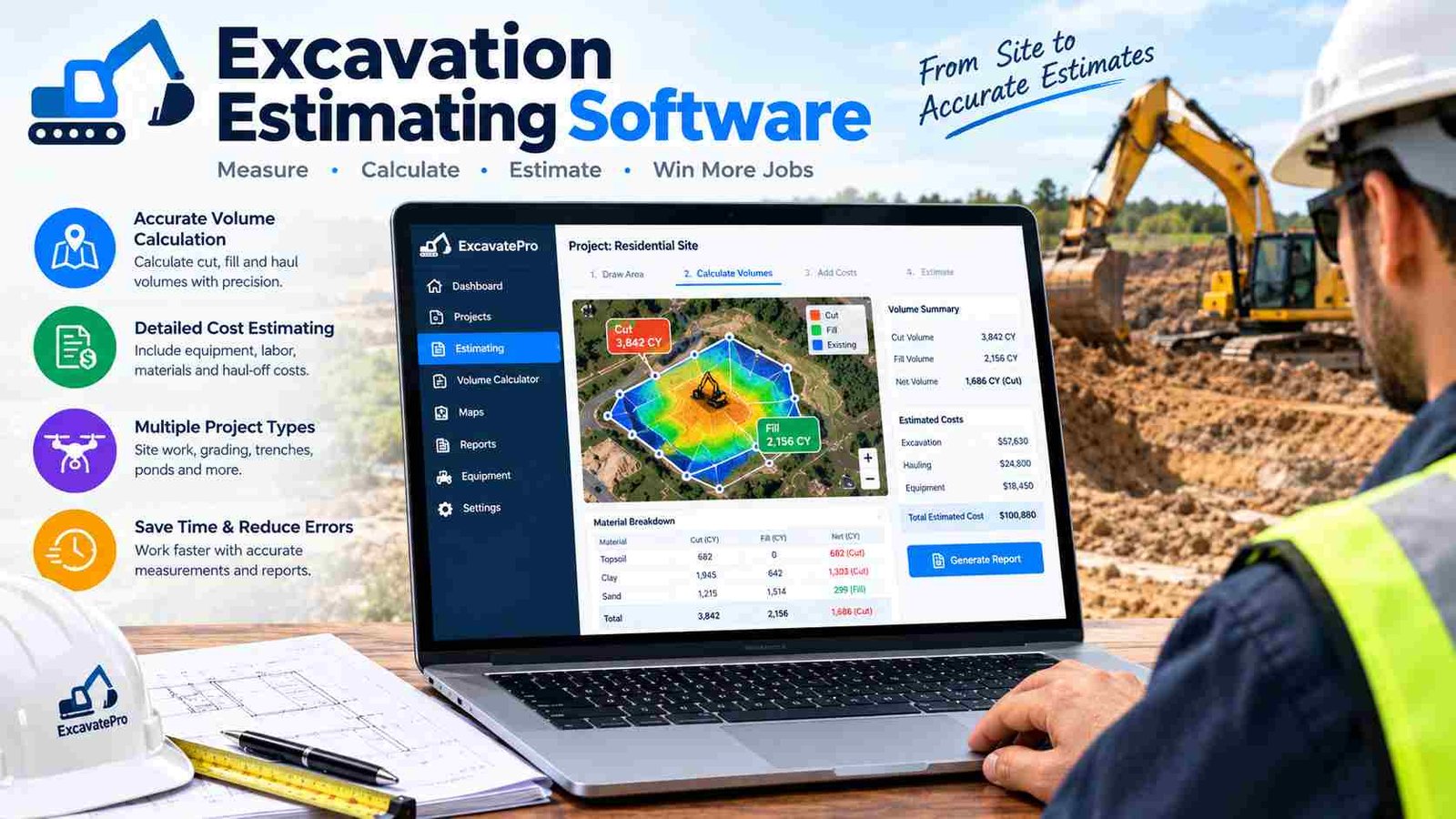
Excavation estimating software is a digital tool that helps contractors calculate earthwork quantities, estimate project costs, and create accurate construction bids. Instead of relying on spreadsheets, paper blueprints, and manual measurements, modern estimating software automates many of the calculations needed for excavation and grading projects.
For excavation contractors, even a small measuring mistake can reduce profit or cause a project to lose money. Manual calculations often lead to errors in cut and fill volumes, trucking costs, labor hours, and equipment usage. Digital estimating tools solve these problems by providing faster and more reliable calculations based on PDF or CAD drawings.
Whether you manage residential grading, commercial site preparation, utility trenching, or heavy civil construction, excavation estimating software helps improve productivity and bidding accuracy. It also creates professional proposals that clients can easily understand.
In this guide, you’ll learn how excavation estimating software works, its most valuable features, the different types available, pricing models, and how to choose the best solution for your business.
What Is Excavation Estimating Software?
Excavation estimating software is specialized construction software designed to calculate the cost of excavation and earthmoving projects. It measures quantities from digital plans, estimates labor and equipment expenses, calculates material volumes and produces complete bid proposals.
Unlike general construction estimating software, excavation estimating software focuses specifically on earthwork. It includes tools for calculating cut and fill, trench volumes, grading quantities, hauling requirements, and soil movement. These calculations are essential for excavation projects but are often missing from standard estimating programs.
Another important distinction is between takeoff software and estimating software. Takeoff software measures dimensions, areas, lengths, and volumes from project drawings. Estimating software uses those measured quantities to calculate costs by adding labor, equipment, materials, overhead, and profit. Many modern platforms combine both functions into one solution.
This software is widely used by excavation contractors, grading companies, utility installation firms, site development contractors, heavy civil construction companies, and earthmoving specialists. From small residential projects to large highway developments, digital estimating improves both accuracy and efficiency.
How Excavation Estimating Software Works?
The estimating process begins by importing project drawings. Most programs support PDF plans, CAD files, and DWG drawings, allowing estimators to work directly from digital blueprints without printing large paper plans.
After importing the plans, the estimator performs a digital takeoff. Using measurement tools, they trace excavation boundaries, calculate lengths, define trench widths, and identify grading areas. The software instantly converts these measurements into square footage, cubic yards, or other required units.
Next comes earthwork calculation. The program determines cut and fill volumes, helping contractors understand how much soil must be removed, transported, or compacted. Many advanced systems also apply swell and shrink factors automatically, producing more realistic hauling estimates.
Once quantities are complete, the estimator adds labor rates, equipment costs, fuel expenses, trucking charges, material prices, and subcontractor costs. Overhead and desired profit margins are included to calculate the final project value.
Finally, the software generates professional bid documents, quantity reports, and detailed cost summaries. These reports can usually be exported as PDF or Excel files, making them easy to share with clients and project teams.
Key Features of Excavation Estimating Software
The strength of excavation estimating software comes from its ability to combine measurements, calculations, and cost management into one workflow. Instead of switching between multiple spreadsheets, contractors can complete an entire estimate within a single platform.
Digital Plan Takeoff
Digital takeoff tools allow users to measure directly from PDF and CAD drawings. Estimators can calculate areas, lengths, depths, slopes, and excavation boundaries with precision. This significantly reduces the time required compared to manual scale rulers and printed blueprints.
Earthwork Volume Calculations
One of the most valuable features is automatic cut and fill calculation. The software determines excavation volumes in cubic yards while considering terrain elevations. It also applies swell and shrink percentages, producing more accurate hauling and disposal estimates.
Cost Estimating
After measuring quantities, users assign labor hours, equipment rates, fuel consumption, trucking costs, and material prices. The software instantly updates the total project value whenever costs change, making bid revisions much faster.
Bid Management
Contractors can create unit-price or lump-sum estimates depending on project requirements. Professional proposal templates present costs clearly, helping clients understand the scope of work and improving the quality of submitted bids.
Reporting and Documentation
Most platforms generate quantity reports, cost breakdowns, bid summaries, and production reports. Export options for Excel and PDF simplify communication with clients, accountants, and project managers.
Types of Excavation Estimating Software
Different excavation businesses require different estimating solutions. Choosing the right type depends on project size, complexity, and workflow.Earthwork takeoff software focuses mainly on measuring excavation quantities and grading volumes. It is ideal for contractors who need accurate digital measurements from plans before creating estimates.Heavy civil estimating software is designed for highways, bridges, airports, and large infrastructure projects. These platforms include production rates, equipment scheduling, crew costing, and complex earthmoving calculations suitable for large-scale operations.
Residential excavation estimating software serves smaller contractors working on foundations, driveways, pools, and residential site preparation. These programs prioritize ease of use, quick estimates, and affordable pricing.
Utility and trench estimating software specializes in underground construction. It calculates trench excavation, pipe bedding, backfill quantities, and utility installation costs with greater accuracy.
Finally, cloud-based excavation estimating software allows teams to collaborate from multiple locations. Estimators, project managers, and business owners can access estimates online, update pricing instantly, and share project data without exchanging spreadsheets.Understanding these categories helps contractors invest in software that matches their daily work rather than paying for unnecessary features.
Benefits of Using Excavation Estimating Software
The biggest advantage of excavation estimating software is improved accuracy. Digital calculations reduce human error and provide consistent quantity measurements across every project. More accurate estimates lead to stronger profit margins and fewer unexpected costs during construction.
Speed is another major benefit. What once required several hours of manual measuring can often be completed in a fraction of the time. Faster estimates allow contractors to bid on more projects without increasing office workload.
The software also improves collaboration. Office estimators, field supervisors, and project managers can work from the same project information, reducing communication mistakes. When project drawings change, quantities and costs update quickly, making change orders much easier to prepare.
Historical cost tracking provides long-term value. Contractors can compare previous projects, analyze production rates, and build more reliable pricing databases. This helps create increasingly accurate bids over time.
Professional reporting is equally important. Clear proposals, organized cost summaries, and detailed quantity reports create a stronger impression during the bidding process. Clients often appreciate transparent estimates that clearly explain labor, equipment, and material costs.Ultimately, excavation estimating software helps businesses win more bids while protecting profitability through better planning and cost control.
Essential Calculations Every Excavation Estimator Should Know
Successful estimating requires understanding several important earthwork calculations. These measurements determine excavation quantities, hauling requirements, and overall project cost.Cut refers to soil removed from higher ground, while fill describes material placed in lower areas to achieve the desired grade. Balancing cut and fill can significantly reduce hauling expenses.Bank Cubic Yards (BCY) measure soil in its natural, undisturbed state before excavation. This is the starting point for most earthwork calculations.
Loose Cubic Yards (LCY) represent excavated soil after it expands. Because soil becomes less compact when removed, its volume increases. This increase is called the swell percentage, and it varies depending on soil type.
Compacted Cubic Yards (CCY) measure soil after it has been placed and compacted. During compaction, soil volume decreases, creating the shrink percentage. Understanding both swell and shrink helps estimate hauling and backfill requirements accurately.
Haul quantity estimation combines excavation volume with truck capacity and haul distance. Even accurate excavation quantities can produce inaccurate bids if trucking time, fuel consumption, and disposal costs are underestimated.Mastering these calculations allows contractors to create realistic bids and avoid expensive surprises during construction.
Best Excavation Estimating Software (Comparison)
Several software solutions are popular among excavation and heavy civil contractors because they specialize in earthwork estimating, digital takeoffs, and production costing.
| Software | Best For | Key Strength |
| HCSS HeavyBid | Heavy civil contractors | Production estimating |
| AGTEK Gradework | Earthwork specialists | 3D cut and fill modeling |
| STACK | Cloud-based teams | Digital takeoff and collaboration |
| PlanSwift | Small contractors | Fast PDF measurements |
| InEight Estimate | Enterprise projects | Advanced cost management |
| Carlson Takeoff | Survey & grading | CAD integration |
Each solution offers different strengths. Smaller businesses often prioritize simplicity and affordability, while larger infrastructure contractors benefit from advanced production analysis, 3D terrain modeling and enterprise reporting features.
How to Choose the Best Excavation Estimating Software?
Choosing excavation estimating software depends on your business size, project type, and future growth plans. The most expensive solution is not always the best choice.
For Small Excavation Businesses
Small contractors should focus on affordable software with an easy learning curve. Fast PDF takeoffs, simple cost templates, and quick proposal generation often provide the greatest value without unnecessary complexity.
For Growing Contractors
As companies expand, job costing and cloud collaboration become more important. Software that allows multiple team members to access estimates and update pricing helps improve productivity across the business.
For Heavy Civil Projects
Large infrastructure projects require advanced capabilities such as 3D terrain modeling, machine control compatibility, production tracking, and detailed reporting. These features support complex excavation operations where precision directly affects profitability.
Before purchasing, test free trials whenever possible. Evaluate ease of use, customer support, reporting quality, and integration with accounting software to ensure the platform fits your workflow.
Excavation Estimating Software vs Excel
Many contractors begin with Excel, but dedicated excavation estimating software offers significant advantages as projects become more complex.
| Feature | Excavation Software | Excel |
| Speed | Fast automated workflow | Mostly manual |
| Accuracy | High with digital calculations | Depends on formulas |
| Volume calculations | Automatic cut & fill | Manual setup |
| Collaboration | Cloud sharing available | Limited |
| Reporting | Professional bid reports | Custom formatting needed |
| Bid generation | Built-in proposals | Manual documents |
| Error reduction | Strong validation tools | Higher risk of mistakes |
Excel remains useful for simple calculations, but specialized software saves time, reduces errors, and creates more professional estimates.
Common Mistakes to Avoid When Estimating Excavation Projects
Even experienced estimators can lose profit through avoidable mistakes. Incorrect plan scaling is one of the most common problems, especially when measurements are taken from improperly calibrated drawings.
Ignoring swell and shrink factors often results in inaccurate hauling estimates. Different soil types expand and compact differently, so using a standard percentage for every project can create costly errors.Another frequent mistake is underestimating haul distance. Trucking costs include travel time, fuel, loading delays, and disposal fees, not just the number of cubic yards being moved.
Equipment idle time should also be included in estimates. Excavators, loaders, and dozers are not productive every minute of the workday, and realistic production rates improve bid accuracy.Finally, always update labor wages, fuel prices, and material costs before submitting a proposal. Outdated pricing can quickly eliminate expected profit.
Industries That Use Excavation Estimating Software
Excavation estimating software supports many industries beyond traditional excavation contractors. Site development companies use it to prepare commercial building lots and industrial facilities. Road construction firms estimate grading, embankments, and highway earthwork for transportation projects.
Residential contractors rely on it for foundation excavation, basement digging, swimming pools, and driveway preparation. Utility contractors calculate trench excavation, backfill, and underground pipe installation for water, sewer, gas, and electrical networks.
Landscaping and drainage specialists estimate ponds, retaining walls, grading improvements, and stormwater management projects. Mining and earthmoving companies also use advanced estimating tools to calculate large-scale material movement and equipment production.Because accurate earthwork calculations are essential across these industries, excavation estimating software has become a valuable planning tool for projects of every size.
Pricing of Excavation Estimating Software
The cost of excavation estimating software varies according to features, business size, and licensing model. Small contractors often choose monthly subscription plans because they require a lower upfront investment and include regular software updates.Annual licenses usually provide better long-term value for businesses that use the software throughout the year. Some vendors also offer per-user pricing, making it easier to add estimators as the company grows.
Enterprise solutions typically use custom pricing based on the number of users, project volume, reporting requirements, and integration needs. These packages often include training, technical support, and implementation services.Many providers offer free trials or demonstration versions. Testing software before purchasing allows contractors to evaluate usability, measurement accuracy, reporting quality, and compatibility with their existing workflow.
When comparing pricing, consider overall value rather than subscription cost alone. Time savings, improved accuracy, and increased bidding success often deliver a stronger return on investment than choosing the lowest-priced option.
Future Trends in Excavation Estimating Software
The future of excavation estimating software is focused on automation, accuracy, and connected jobsite technology. Artificial intelligence is beginning to assist estimators by identifying quantities, suggesting production rates, and reducing repetitive manual work.
Drone surveys are becoming increasingly valuable for measuring existing site conditions. Combined with aerial mapping and 3D terrain models, they create highly accurate earthwork calculations before construction begins.
Cloud collaboration allows office and field teams to work from the same project data in real time. Changes made by one team member become instantly available to everyone, improving communication and reducing costly misunderstandings.GPS machine control integration is another growing trend. Estimating data can connect directly with grading equipment, helping operators work more accurately while reducing rework.
Automated quantity extraction from digital plans will continue improving, allowing contractors to complete estimates faster while maintaining consistent accuracy across increasingly complex excavation projects.
Frequently Asked Questions
1. Can excavation estimating software work without CAD drawings?
Yes. Most modern programs support PDF plans, allowing contractors to perform digital takeoffs even when CAD files are unavailable.
2. Is excavation estimating software suitable for small businesses?
Absolutely. Many solutions are designed specifically for small excavation companies and include affordable pricing, simple interfaces, and quick estimating tools.
3. How does excavation estimating software improve profit margins?
It reduces measuring errors, updates costs quickly, improves labor and equipment calculations, and creates more accurate bids that protect project profitability.
4. Can the software estimate trench excavation separately?
Yes. Utility and trench estimating features calculate trench volumes, bedding materials, backfill quantities, and related excavation costs.
5. Does excavation estimating software integrate with accounting systems?
Many platforms offer integration with Excel and popular accounting software, making it easier to transfer project costs, invoices, and job costing data.
Conclusion
Excavation estimating software has become an essential tool for contractors who want faster, more accurate, and more profitable project estimates. By replacing manual calculations with digital takeoffs, automated earthwork measurements, and professional cost reporting, businesses can reduce errors and submit stronger bids with confidence.
Whether you operate a small residential excavation company or manage large heavy civil projects, choosing the right software depends on your workflow, project complexity, and budget. Investing in the right estimating solution can improve efficiency, strengthen profitability, and help your business compete successfully in today’s construction industry.