Introduction
Every engineering project creates a huge number of documents, from CAD drawings and BIM models to technical reports, equipment datasheets, contracts, and revision files. Managing these documents manually becomes difficult as projects grow in size and involve multiple teams. That is where engineering document management software becomes essential.
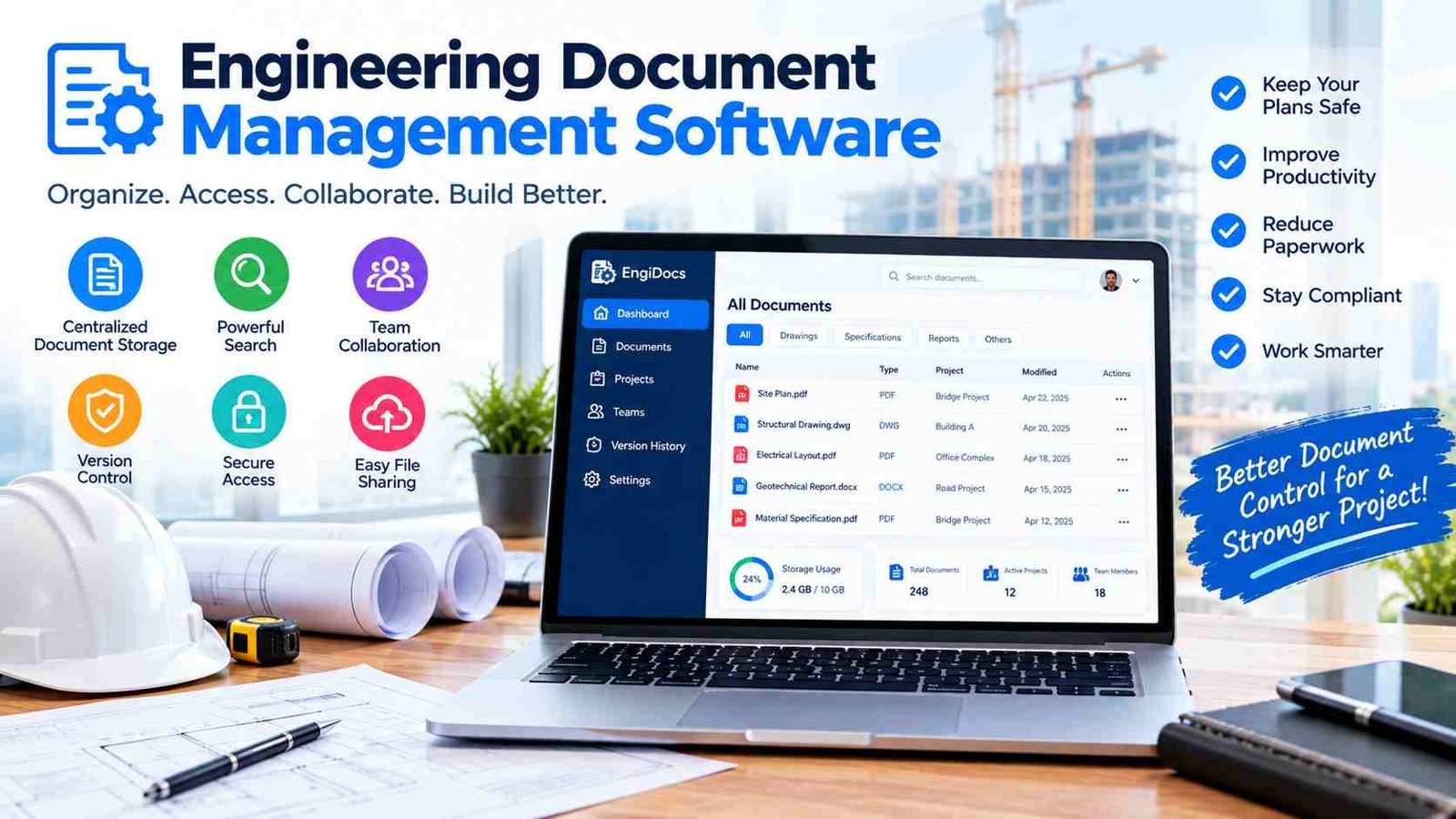
An Engineering Document Management System (EDMS) is designed to store, organize, track, and protect technical documents throughout their lifecycle. Instead of searching through paper files, email attachments, or shared folders, engineers can quickly find the latest approved version of any document from a centralized repository. This reduces errors, prevents duplicate work, and improves collaboration between office and field teams.
Version control is especially important because even one outdated drawing can lead to expensive construction mistakes or manufacturing delays. Modern EDMS platforms also support digital approvals, audit trails, and regulatory compliance, making them valuable for industries with strict quality standards.
In this guide, you will learn how engineering document management software works, its core features, major benefits, implementation best practices, and how to choose the right solution for your business.
What Is Engineering Document Management Software?
Engineering document management software is a specialized system that helps engineering organizations create, organize, control, and distribute technical documents securely. Unlike a general document storage tool, an EDMS is built specifically for managing engineering files that require strict revision control and approval workflows.
At its core, an Engineering Document Management System acts as a single source of truth. Every authorized team member accesses the same up-to-date drawings, specifications, and project documents, eliminating confusion caused by multiple file copies. The software stores documents in a centralized repository where they can be searched using metadata such as project number, discipline, equipment tag, or revision level.
An EDMS manages many types of engineering documents, including DWG CAD drawings, BIM models in RVT or IFC formats, technical specifications, RFIs, submittals, equipment datasheets, contracts, PDFs, inspection reports, and engineering calculations. These documents remain connected throughout the project lifecycle, making collaboration much more efficient.
The software is widely used by civil, structural, mechanical, and electrical engineers, as well as EPC contractors, manufacturing companies, utilities, mining operations, and infrastructure organizations. Whether designing a bridge or managing a power plant, engineering teams rely on accurate document control to maintain quality, safety, and compliance.
Why Do Engineering Firms Need Document Management Software?
Engineering projects involve hundreds or even thousands of document revisions. Without a structured management system, teams often struggle with outdated drawings, misplaced files, confusing email attachments, and manual approval processes. These problems waste valuable time and increase the chance of costly mistakes.
One of the biggest challenges is version confusion. An engineer may accidentally use Revision B while another department is already working on Revision D. This simple mistake can result in incorrect manufacturing, construction rework, or delayed project delivery. Shared folders also make it difficult to know which document is officially approved.
Poor document control creates significant business risks. Construction delays, compliance violations, safety incidents, client disputes, and expensive rework are often linked to inaccurate or missing documentation. Regulatory industries require complete traceability, making manual systems unreliable for modern engineering operations.The table below shows the difference between traditional document handling and a dedicated EDMS.
| Manual Document Management | Engineering Document Management Software |
| Paper folders | Centralized cloud repository |
| Manual revisions | Automatic version control |
| Email approvals | Workflow automation |
| Difficult search | Intelligent metadata search |
| High risk of errors | Full document traceability |
By replacing manual processes with digital workflows, engineering firms improve accuracy, reduce operational risk, and increase project efficiency.
How Engineering Document Management Software Works?
An Engineering Document Management System follows a structured workflow that controls documents from creation to long-term storage. Every stage is recorded, ensuring transparency and accountability across engineering teams.
The process begins with document capture. Teams upload digital files, scan paper records, or import CAD and BIM models directly into the system. Once uploaded, documents are automatically categorized using metadata such as project ID, engineering discipline, equipment tag, revision number, and asset information. This makes searching much faster than browsing through folders.
The next stage is version control. Engineers check documents in and out before editing, preventing multiple people from changing the same file simultaneously. Every revision is stored with a complete history, allowing users to compare versions or restore previous revisions if necessary. Superseded drawings remain archived but are clearly marked to prevent accidental use.
Finally, documents move through an approval workflow where reviewers add comments, request changes, and provide digital approvals before release.This controlled lifecycle ensures every released document is accurate, approved, and easy to retrieve in the future.
Core Features of Engineering Document Management Software
A modern EDMS offers much more than simple file storage. Its specialized features help engineering organizations manage complex technical documentation efficiently.
Version control and revision tracking ensure that every drawing or specification has a complete edit history. Engineers can identify who made changes, when revisions occurred, and why updates were approved. This prevents accidental use of outdated documents.
CAD and BIM file management allows native engineering files to remain organized without breaking references. Teams working with AutoCAD, Revit, or IFC models can collaborate while maintaining file integrity.
Metadata and intelligent search dramatically reduce search time. Instead of remembering file names, users can locate documents using project numbers, equipment tags, locations, disciplines, or revision codes.
Role-based permissions protect sensitive information by allowing administrators to control who can view, edit, approve, or download specific documents. This is especially useful for contractors and external consultants.
Audit trails record every user action, creating complete transparency for quality audits and regulatory inspections. Automated approval workflows replace paper signatures with digital review cycles, reducing delays and improving accountability.
Finally, mobile access enables field engineers to retrieve approved drawings directly from tablets or smartphones, while secure cloud backup protects valuable engineering records from hardware failures or accidental deletion. These capabilities create a reliable environment for both office and site teams.
Engineering Document Management Software vs Generic Document Management Software
Although generic document management systems are useful for storing office files, they lack the specialized capabilities required by engineering organizations. Technical projects depend on revision accuracy, CAD compatibility, equipment metadata, and structured approval processes that ordinary document systems rarely provide.
A dedicated engineering document management software platform understands engineering workflows. It manages drawing revisions, supports BIM collaboration, maintains transmittals, and creates detailed audit histories for regulated industries. These functions are essential for construction, manufacturing, utilities, and industrial projects where documentation directly affects operational safety and quality.
| Feature | Engineering EDMS | Generic DMS |
| CAD support | ✅ Full | Limited |
| BIM files | ✅ Yes | Rare |
| Revision control | Advanced | Basic |
| Engineering workflows | Yes | Limited |
| Equipment metadata | Yes | No |
| Transmittals | Yes | Rare |
| Compliance support | Strong | Moderate |
For engineering firms, choosing specialized software is not simply about storing documents—it is about ensuring every technical decision is supported by accurate, traceable, and approved information throughout the project lifecycle.
Key Benefits of Engineering Document Management Software
The greatest advantage of engineering document management software is its ability to improve both productivity and project quality. Engineers spend less time searching for files and more time solving technical problems.
Faster document retrieval allows project teams to locate drawings, specifications, or reports within seconds using metadata filters. This is especially valuable on large infrastructure projects where thousands of documents exist across multiple disciplines.
Reduced rework is another major benefit. When everyone accesses the latest approved revision, construction teams avoid building from outdated drawings. This saves materials, labor costs, and valuable project time.
Collaboration also improves because architects, engineers, contractors, and clients can review documents within a shared platform. Comments, markups, and approvals remain connected to the document instead of being scattered across email conversations.
For regulated industries, audit trails and digital approvals simplify compliance with quality management standards. Security features such as encryption, access permissions, and automated backups protect confidential engineering information from unauthorized access.
A practical example is a manufacturing company updating equipment layouts across three factories. With an EDMS, every facility immediately receives the newest approved drawing, ensuring consistent implementation while maintaining a complete revision history for future maintenance.
Industries That Use Engineering Document Management Software
Engineering document control is valuable across many industries because technical information must remain accurate throughout the asset lifecycle.
Construction and EPC companies manage drawings, RFIs, submittals, and contractor documentation for complex projects. Manufacturing organizations control product drawings, assembly instructions, quality records, and equipment documentation. Oil and gas companies rely on document traceability for plant safety, maintenance, and regulatory compliance.
Utility providers manage electrical networks, water systems, and infrastructure assets where accurate documentation supports long-term maintenance. Mining companies organize geological reports, equipment records, and environmental documentation for remote operations.
In renewable energy, solar and wind projects require careful management of engineering calculations, installation drawings, and commissioning reports. Aerospace manufacturers maintain strict revision control for highly regulated technical documentation. Architecture and AEC firms coordinate BIM models and multidisciplinary design files, while industrial plants use EDMS platforms to manage maintenance manuals, process diagrams, and operational procedures.Although each industry has different workflows, they all share one common goal: ensuring the right people always access the correct technical document at the right time.
Best Engineering Document Management Software Solutions
Several well-known platforms offer powerful document management capabilities for engineering organizations. The ideal choice depends on project size, CAD requirements, compliance needs and budget.
| Software | Best For | Key Strength |
| Autodesk Vault | CAD teams | AutoCAD integration |
| Teamcenter | Enterprise | PLM & revision control |
| OpenText | Large organizations | Compliance |
| M-Files | Growing businesses | Smart metadata search |
| Synergis Adept | Engineering drawings | Revision management |
| Oracle Aconex | Construction | Document control |
Smaller engineering firms often prioritize ease of use and affordable cloud deployment, while enterprise organizations usually require advanced compliance, PLM integration, and multi-site collaboration. Rather than selecting the most popular platform, businesses should evaluate which solution matches their workflow, document volume, and long-term growth strategy.
How to Choose the Right Engineering Document Management Software?
Selecting the right EDMS begins with understanding your organization’s operational needs instead of focusing only on software features. A company managing five engineers has very different requirements from an international EPC contractor handling millions of project documents.
Start by evaluating team size and expected document volume. Next, verify compatibility with CAD and BIM applications already used by your designers. Native integration reduces manual file transfers and preserves engineering references.
Workflow automation is equally important. Look for configurable review cycles, digital approvals, and automated notifications that match your internal quality procedures. Security should include role-based permissions, encryption, audit logs, and reliable backup options.
Organizations must also compare cloud and on-premise deployment. Cloud solutions offer easier remote collaboration, while on-premise systems may better satisfy certain regulatory or internal IT requirements.
Buyer’s Checklist
- Supports CAD and BIM files
- Advanced version control
- Metadata search
- Digital approval workflows
- Role-based security
- Mobile field access
- Compliance reporting
- Scalable pricing model
Choosing software based on real operational requirements leads to better adoption and stronger long-term value.
Engineering Document Management Software Implementation Guide
Successful implementation depends as much on planning as it does on technology. Before migrating documents, engineering firms should audit existing files and remove duplicates or obsolete records. Clean data creates a stronger foundation for the new system.
The next step is designing a logical folder structure combined with consistent metadata. Project IDs, disciplines, equipment tags, and revision codes should follow standardized naming rules across the organization.Legacy drawings, PDFs, and historical reports are then imported while preserving revision history wherever possible. After migration, administrators configure user permissions so engineers, managers, contractors, and clients receive appropriate access levels.
Approval workflows should reflect real engineering processes, including review stages, comment resolution, and final release procedures. Finally, comprehensive employee training ensures everyone understands how to upload documents, manage revisions, and follow standardized workflows.
The most successful implementations begin with one pilot project before expanding across the entire organization. This approach allows teams to refine processes, improve user adoption and resolve workflow issues before large-scale deployment.
Best Practices for Managing Engineering Documents
Effective document control depends on consistent standards rather than software alone. Organizations should create clear naming conventions so every file follows the same structure. Revision numbering should remain standardized across departments to prevent confusion during project updates.
Metadata consistency is equally important because accurate tags improve search results and reporting. Access control policies should follow the principle of least privilege, allowing users to access only the documents required for their role.
Regular document audits help identify obsolete files, duplicate records, and missing approvals. Automated backup and disaster recovery plans protect valuable engineering information from unexpected failures, while document retention policies ensure historical records remain available for maintenance, legal, and compliance purposes.
Common Mistakes to Avoid
Many organizations invest in powerful software but continue using old habits that reduce its effectiveness. Saving files outside the EDMS creates multiple versions and weakens document control. Ignoring revision history increases the chance of using outdated drawings during construction or manufacturing.
Poor metadata tagging makes documents difficult to find, even in advanced systems. Giving every employee editing permission also increases accidental changes and security risks. Skipping formal approval workflows removes accountability, while inadequate staff training often leads to inconsistent document management practices.Avoiding these common mistakes helps engineering teams gain the full value of their document management investment.
Future Trends in Engineering Document Management Software
The future of engineering document management software is becoming increasingly intelligent. Artificial intelligence can automatically classify technical documents and suggest metadata during upload, reducing manual administrative work.
Automated metadata extraction uses machine learning to recognize project numbers, equipment tags, and revision information directly from engineering drawings and PDFs. Digital twin integration connects documents with real physical assets, allowing maintenance teams to access manuals and drawings by selecting equipment within a virtual model.
BIM and GIS connectivity is also improving, making it easier to combine building models with geographic infrastructure data for smarter planning. Meanwhile, cloud collaboration enables global engineering teams to work together in real time while maintaining secure document control across multiple offices and project locations.
Frequently Asked Questions
1. Can engineering document management software work with AutoCAD and Revit?
Yes. Many EDMS platforms support AutoCAD DWG files and Revit BIM models, allowing engineers to manage revisions without losing file relationships.
2. How does metadata improve document searching?
Metadata adds searchable information such as project ID, equipment tag, discipline, and revision number, making documents much easier to locate than traditional folder browsing.
3. Is cloud-based engineering document management software secure?
Yes. Reputable cloud platforms typically include encryption, role-based access control, audit logs, and automated backups to protect confidential engineering documents.
4. How long does it take to implement an EDMS?
Implementation varies by organization, but small businesses may complete deployment in a few weeks, while large enterprise projects can take several months depending on document volume and workflow complexity.
5. What is the biggest benefit of using engineering document management software?
The biggest benefit is maintaining a single source of truth, ensuring every team member always works with the latest approved engineering documents while reducing errors and improving collaboration.
Conclusion
Engineering projects succeed when teams can trust their documentation. Engineering document management software provides a centralized, secure, and organized environment where drawings, specifications, reports, and revisions remain accurate throughout the project lifecycle.
By improving version control, collaboration, compliance, and document security, an EDMS reduces costly errors while increasing productivity for both office and field teams. Whether you work in construction, manufacturing, utilities, or industrial engineering, choosing the right platform should be based on your workflow, team size, integration needs, and long-term business goals. A well-implemented document management system becomes more than storage—it becomes the foundation of reliable engineering operations.