Introduction
Ocean freight moves around 80–90% of global trade by volume, making it one of the most important parts of international supply chains. Every day, importers, exporters, freight forwarders, and third-party logistics providers coordinate thousands of container shipments across oceans. Managing those shipments manually with spreadsheets, emails, and paper documents is slow, error-prone, and difficult to scale.
Ocean freight management software solves these challenges by bringing booking, documentation, container tracking, customs compliance, billing, and customer communication into one digital platform. Instead of searching through multiple emails or updating spreadsheets, logistics teams can monitor shipments in real time, generate shipping documents automatically, and collaborate with customers and carriers more efficiently.
Whether you operate a small freight forwarding company or manage a global supply chain, the right software improves visibility, reduces delays, and helps maintain regulatory compliance. In this guide, you’ll learn what ocean freight management software is, how it works, its essential features, key business benefits, leading software solutions, and how to choose the best platform for your logistics operations.
What Is Ocean Freight Management Software?
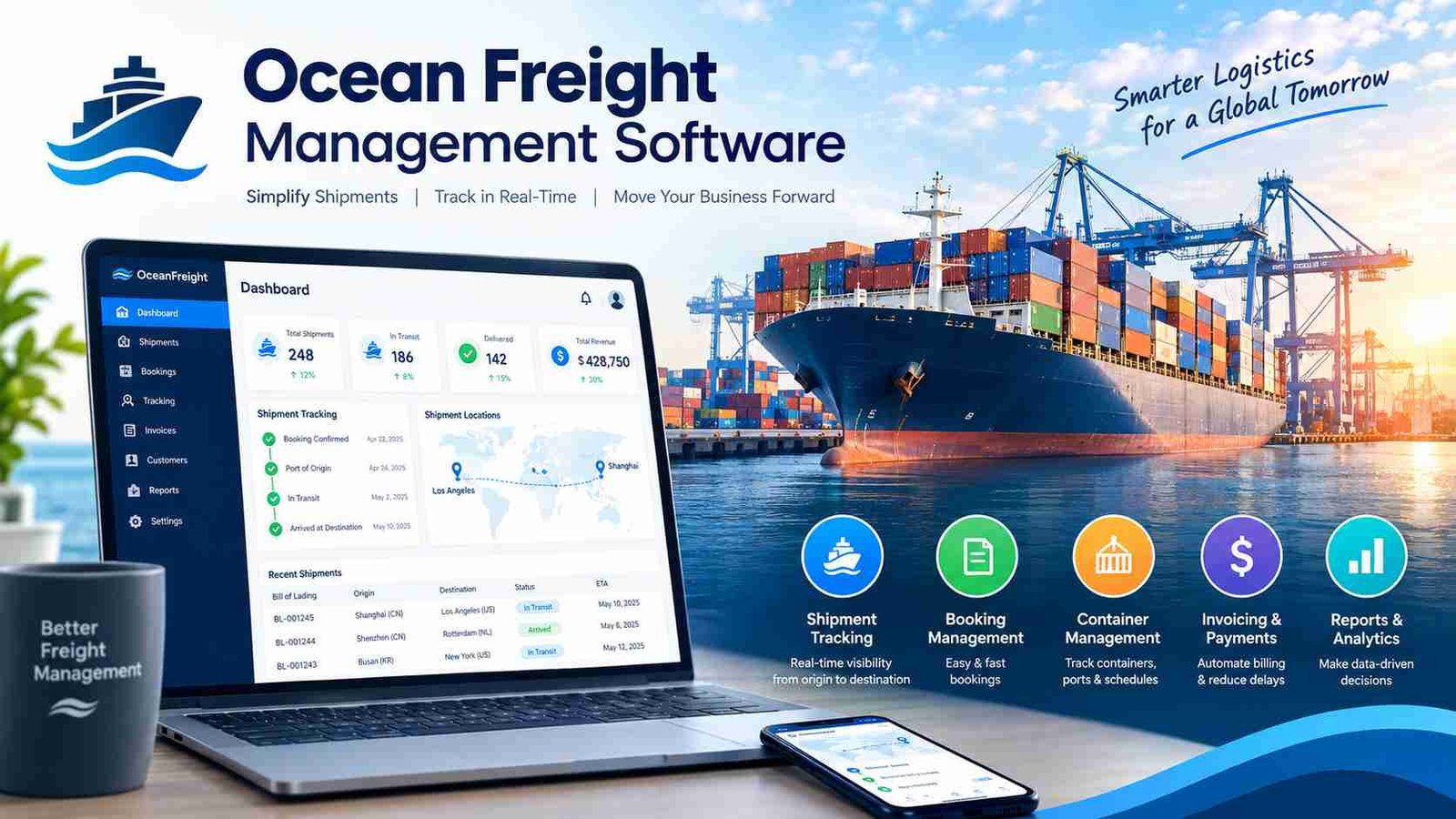
Ocean freight management software is a specialized digital solution designed to manage the complete lifecycle of sea freight shipments. It helps businesses organize bookings, compare carrier rates, prepare shipping documents, track containers, handle customs requirements, and generate invoices from one centralized system.
Unlike basic logistics tools, this software focuses specifically on ocean transportation. It supports both Full Container Load (FCL) and Less than Container Load (LCL) shipments while integrating with shipping lines, ports, customs authorities, and accounting systems. The goal is to reduce manual work while improving shipment accuracy and operational visibility.
How is it different from a generic TMS?
A Transportation Management System (TMS) usually manages multiple transportation modes such as road, rail, air, and sea. Ocean freight management software goes deeper into maritime logistics by including vessel schedules, container milestones, Bills of Lading, port operations, and ocean carrier integrations. Many businesses use it as a dedicated ocean module within their broader logistics technology stack.
Who uses ocean freight software?
The software serves a wide range of industries. Freight forwarders use it to coordinate customer shipments efficiently. NVOCCs manage container allocations and documentation. Import and export companies monitor international orders, while logistics providers improve customer service through shipment visibility. Manufacturers track inbound raw materials, and retail supply chains ensure products arrive on schedule across global markets.
Throughout the logistics industry, ocean freight software, freight forwarding software, and ocean logistics software have become essential tools for improving productivity and reducing operational risk.
How Ocean Freight Management Software Works?
Every ocean shipment follows a structured workflow, and modern software automates each stage from quotation to final delivery. This reduces repetitive tasks and ensures that every stakeholder has access to accurate information throughout the shipment journey.
Customer quote request & rate management
The process begins when a customer requests a shipping quote. The software stores shipment details such as origin, destination, cargo type, container size, and delivery requirements. It then compares contract rates, spot market prices, fuel surcharges, and carrier options to produce an accurate quotation within minutes.
Carrier booking & documentation
After approval, logistics teams book space with the selected ocean carrier. The platform generates booking confirmations, shipping instructions, packing lists, commercial invoices, and Bills of Lading automatically. This minimizes typing errors and ensures consistent documentation across every shipment.
Tracking, customs & delivery
During transit, the software receives vessel updates and container milestones through carrier integrations. Teams monitor ETAs, receive delay alerts, complete customs filings, and manage compliance records. Once cargo reaches its destination, proof of delivery is recorded, invoices are issued, vendor payments are processed, and shipment profitability is calculated for financial reporting.
Core Features of Ocean Freight Management Software
The strength of any ocean freight platform lies in its ability to manage multiple logistics functions within one connected system. Rather than switching between separate applications, businesses can control bookings, documentation, tracking, finance, and customer communication from a single dashboard.
Ocean booking management
Booking management allows operators to schedule FCL and LCL shipments while accessing real-time sailing schedules. Users can reserve container space, confirm carrier bookings, manage amendments, and coordinate multiple shipments without relying on lengthy email conversations.
Freight rate management
Freight pricing changes frequently due to market conditions. Advanced software stores contract rates, spot quotations, surcharges, and customer-specific pricing rules. Teams can instantly compare carrier costs and create professional quotations that improve response time and pricing accuracy.
Bill of Lading management
One of the most valuable features is automated document generation. The platform creates Master Bills of Lading (MBL), House Bills of Lading (HBL), shipping instructions, and telex release documentation while reducing paperwork and improving compliance.
Container tracking & visibility
Real-time tracking gives customers and logistics teams complete shipment visibility. Users can monitor vessel locations, port arrivals, departure milestones, estimated arrival times, and unexpected delays through automated notifications.
Customs, billing & customer portal
The software also manages customs documents including commercial invoices, packing lists, ISF filing support, AMS records, and compliance history. Integrated accounting generates customer invoices, vendor bills, multi-currency transactions, and profit reports for every shipment. Many platforms also include customer portals where clients can track cargo, download documents, review shipment history, and access invoices independently.
Types of Ocean Freight Managed by the Software
Ocean freight management software supports different shipping models because international cargo varies in size, urgency, and transportation requirements. The software adapts its workflow depending on the shipment type while maintaining centralized visibility.
Full Container Load (FCL) shipments occupy an entire container and are commonly used by manufacturers, wholesalers, and retailers moving large cargo volumes. The software simplifies container allocation, sailing schedules, and direct carrier bookings.
Less than Container Load (LCL) shipments combine cargo from multiple customers into one container. Freight forwarders use the software to manage consolidation, calculate shared freight costs, and coordinate deconsolidation at destination warehouses.
Beyond FCL and LCL, the platform supports import shipments, export shipments, and complete door-to-door logistics. It tracks inland transportation, port handling, customs clearance, and final delivery, providing businesses with a complete view of international cargo movement from origin to destination.
Key Benefits of Ocean Freight Management Software
The biggest advantage of digital freight management is operational efficiency. Businesses save time, reduce costs, and improve customer satisfaction by replacing manual processes with intelligent automation.
Faster shipment processing allows teams to create quotations, confirm bookings, and generate shipping documents within minutes instead of hours. Automated workflows eliminate repetitive data entry, reducing human error and allowing staff to focus on customer service and strategic logistics planning.
Better communication is another major benefit. Customers receive real-time shipment updates instead of requesting status reports by email. This transparency builds trust and reduces support inquiries.
Compliance also improves significantly because required documents are stored digitally and generated using standardized templates. Companies reduce documentation mistakes that can delay customs clearance or create costly penalties.
Finally, detailed reporting helps businesses understand profitability at the shipment level. Managers can analyze carrier costs, customer revenue, transit performance, and operational efficiency, making better decisions that improve long-term financial performance.
Ocean Freight Software vs Traditional Manual Freight Management
Many logistics companies still depend on spreadsheets and email chains, but digital freight platforms provide much greater accuracy and visibility.
| Manual Process | Ocean Freight Management Software |
| Email-based bookings | Centralized booking management |
| Paper shipping documents | Digital document generation |
| Manual container tracking | Real-time shipment visibility |
| Spreadsheet rate calculations | Automated freight rate comparison |
| Separate invoicing systems | Integrated billing & accounting |
| Limited operational reports | Live analytics & profitability insights |
As shipment volumes grow, manual systems become increasingly difficult to maintain. Ocean freight software creates a single source of truth, helping teams collaborate more effectively across multiple offices and international partners.
Essential Integrations Every Business Should Look For
A powerful freight platform should connect seamlessly with the other systems used across the supply chain. Integrations eliminate duplicate data entry and ensure information flows automatically between departments.
Ocean carrier APIs provide live sailing schedules, booking confirmations, and container tracking updates directly from shipping lines. Port and terminal systems supply gate movements, container availability, and operational milestones that improve shipment visibility.
Customs platform integration simplifies regulatory compliance by supporting electronic filing and document submission. ERP software connects logistics operations with purchasing, inventory, and finance, while accounting systems automate invoicing, tax calculations, and payment reconciliation.
Warehouse Management Systems (WMS) synchronize inventory movements before and after ocean transport. CRM integration gives sales and customer service teams immediate access to shipment status, helping them respond quickly to customer inquiries and improve overall client satisfaction.
How to Choose the Best Ocean Freight Management Software?
Choosing the right platform requires evaluating business needs rather than simply selecting the software with the longest feature list. The best solution should support your current operations while remaining flexible enough for future growth.
Scalability is important if your shipment volume continues to increase or your business expands internationally. Multi-office support allows teams across different regions to work within the same platform while maintaining local operational control.
Ease of use should never be overlooked. A clean interface reduces training time and encourages faster adoption by operations staff. Security features such as user permissions, audit trails, and document access controls help protect sensitive customer and shipment information.
Reporting dashboards provide valuable insights into delivery performance, carrier costs, customer profitability, and operational efficiency. Businesses should also compare cloud-based and on-premise deployment options, evaluate customer support quality, and understand pricing models including subscription fees, implementation costs, and optional integrations before making a final decision.
Best Ocean Freight Management Software Solutions
Several well-known logistics platforms serve different business sizes and operational needs. The right choice depends on whether your priority is freight forwarding, enterprise logistics, or shipment visibility rather than a single universally best product.
| Software | Best For |
| GoFreight | Freight forwarders and shipment operations |
| BuyCo | Container visibility and collaboration |
| Flexport | End-to-end international logistics |
| GoComet | Rate management and vessel tracking |
| Shipthis | Freight forwarding workflow automation |
| SAP TM | Large enterprise transportation management |
Each platform offers different strengths, so businesses should evaluate integrations, scalability, pricing, reporting, and customer support alongside core freight management capabilities.
Common Challenges Solved by Ocean Freight Software
International shipping involves many moving parts, and even small mistakes can create expensive delays. Ocean freight management software addresses these operational problems through automation and centralized information.
Lost shipping documents become much less common because Bills of Lading, invoices, packing lists, and customs files are stored digitally with searchable records. Delayed container updates are reduced through real-time carrier integrations that provide automatic milestone notifications.
The software also helps minimize demurrage and detention costs by alerting teams before free-time deadlines expire. Duplicate data entry disappears because shipment information flows across booking, documentation, tracking, and billing modules automatically.
Customer visibility improves through self-service portals where clients can monitor cargo without contacting support. Finally, integrated financial tools simplify invoice reconciliation by matching vendor charges, customer invoices, and shipment costs within one connected accounting workflow.
Future Trends in Ocean Freight Management Software
Digital transformation continues to reshape global shipping, and future freight platforms will become even more intelligent. Artificial intelligence is already improving ETA prediction by analyzing vessel speed, weather conditions, port congestion, and historical transit data.
Predictive supply chain analytics will help businesses identify potential disruptions before they occur, allowing logistics teams to reroute shipments or adjust inventory planning proactively. Automated document processing using optical character recognition (OCR) will further reduce manual paperwork and improve data accuracy.
API-first logistics ecosystems will connect carriers, ports, customs authorities, warehouses, and customers through real-time data sharing. Digital freight collaboration portals will also strengthen communication between every participant in the shipment process, creating more transparent and resilient international supply chains for businesses of all sizes.
Frequently Asked Questions
1. What is the biggest advantage of ocean freight management software?
The biggest advantage is centralized control. It combines booking, documentation, tracking, customs and billing into one platform, reducing manual work and improving shipment visibility.
2. Can small freight forwarding companies use ocean freight software?
Yes. Many cloud-based solutions are designed for small and medium-sized freight forwarders, offering affordable subscription plans without requiring expensive infrastructure.
3. Does the software support both import and export shipments?
Most modern platforms manage complete import and export workflows, including bookings, customs documents, container tracking, and delivery confirmation.
4. How does real-time container tracking improve customer service?
Customers receive automatic shipment updates, accurate ETAs, and delay notifications, reducing the need for manual status requests and improving communication.
5. Is ocean freight management software suitable for multi-office logistics businesses?
Yes. Many systems support multiple branches, user permissions, shared shipment databases and centralized reporting across different countries and regional offices.
Conclusion
Ocean freight management software has become an essential tool for businesses involved in international shipping. It replaces disconnected spreadsheets, emails, and paper documents with a unified platform that manages bookings, documentation, container tracking, customs compliance, billing, and customer communication. By improving visibility and automating repetitive tasks, the software helps logistics teams reduce errors, control costs and deliver better customer service.
Whether you’re a freight forwarder, importer, manufacturer, or 3PL provider, choosing the right solution can increase operational efficiency and support long-term business growth. Investing in the right ocean freight management software is not just a technology upgrade. It is a smarter way to manage global logistics.