Introduction
Modern software must do much more than simply work. It needs to handle thousands of users, protect sensitive data, connect with other systems, and grow as a business expands. This is where software architecture consulting becomes valuable. It helps companies build strong technical foundations before small software problems become expensive business problems.
Many organizations face issues such as slow applications, difficult maintenance, rising cloud costs, and systems that cannot scale. Instead of constantly fixing these issues, architecture consultants design reliable solutions that improve performance, security, and long-term flexibility.
In this guide, you will learn what software architecture consulting is, the services consultants provide, different architecture patterns, cloud strategies, pricing, industry use cases, and practical tips for choosing the right consulting partner.
What Is Software Architecture Consulting?
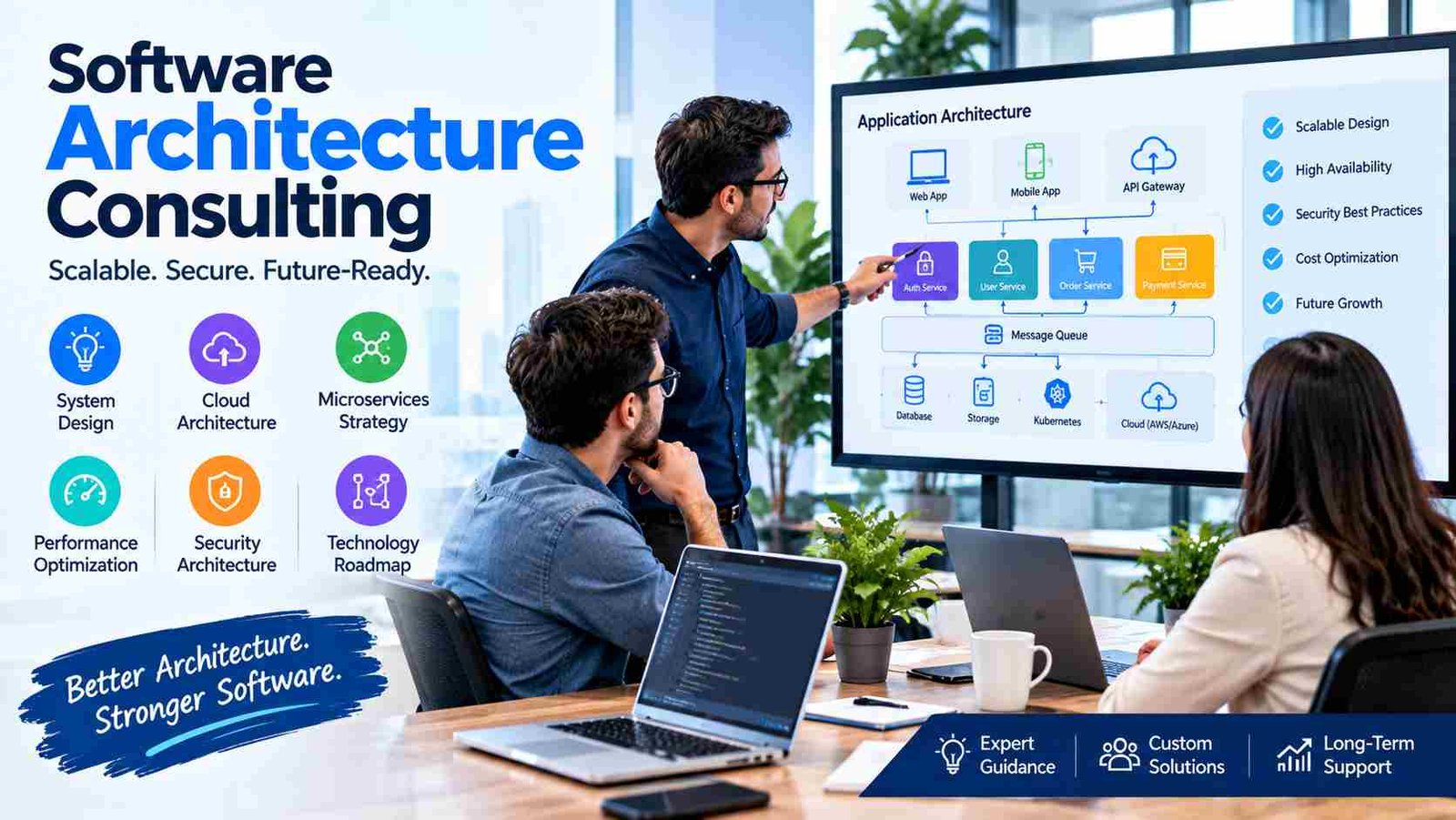
Software architecture consulting is a professional service that helps businesses design, improve, and optimize the structure of their software systems. Instead of focusing only on writing code, consultants create the overall blueprint that defines how applications, databases, APIs, and cloud infrastructure work together.
The consulting process usually begins with understanding business goals and technical challenges. Architects review the existing system, identify performance bottlenecks, evaluate technical debt, and recommend an architecture that supports future growth. They also prepare documentation and implementation roadmaps for development teams.
It is important to understand the difference between software architecture, software design, and software development. Architecture defines the overall system structure, design focuses on individual components and user experience, while development turns those designs into working applications.
Many organizations benefit from architecture consulting. Startups use it to build scalable products from day one. SaaS companies improve reliability for growing customers. Large enterprises modernize legacy systems, while healthcare, fintech, and e-commerce businesses require secure and compliant architectures that handle sensitive data and high transaction volumes.
Why Is Software Architecture Consulting Important?
A strong software architecture creates the foundation for reliable digital products. Without proper planning, businesses often experience slow performance, expensive maintenance, and systems that become difficult to scale as customer demand increases.
One of the biggest advantages is improved scalability. Architecture consultants design systems that can support increasing users without major redesigns. This is especially important for cloud applications and online platforms where traffic can grow rapidly. Another benefit is reducing technical debt. Many companies add quick fixes over time, making software more complex and harder to maintain. Consultants identify these issues early and recommend cleaner structures that reduce future development costs.
Performance is also greatly improved through optimized databases, caching strategies, efficient APIs, and better infrastructure planning. Security receives equal attention by applying secure authentication, encryption, access control, and compliance practices suitable for industries like healthcare and finance. Most importantly, architecture consulting supports long-term business growth. When software is flexible and well documented, companies can introduce new features, integrate third-party services, and expand into new markets without rebuilding their entire platform.
Core Services Included in Software Architecture Consulting
The scope of software architecture consulting goes far beyond reviewing code. Consultants provide strategic and technical services that improve software quality throughout its lifecycle.
An architecture assessment begins with analyzing the current application, infrastructure, databases, and integrations. This audit identifies performance issues, security risks, and areas of technical debt. Consultants then evaluate how the existing system supports business objectives and whether modernization is necessary.
The next stage is target architecture design. Here, architects create a future-ready blueprint that defines application layers, cloud infrastructure, database selection, API communication, and deployment strategy. Cloud architecture consulting helps organizations migrate applications to platforms such as AWS, Azure, or Google Cloud while maintaining availability and controlling costs.
Database optimization ensures efficient storage, indexing, and data access. API and integration architecture focuses on reliable communication between internal services and external applications. Finally, architecture governance establishes coding standards, documentation, review processes, and technical guidelines that keep development teams aligned.Typical project deliverables include:
| Deliverable | Purpose |
| Architecture diagrams | Visual system blueprint |
| Technology roadmap | Future development plan |
| Risk report | Technical and security risks |
| Migration strategy | Cloud or legacy transition plan |
| Best-practice documentation | Standards for development teams |
Types of Software Architecture Consultants
Different business challenges require different architecture specialists. Understanding these roles helps companies choose the right expert for their project.
A Solution Architect designs solutions for specific business problems and ensures applications meet customer and operational requirements. An Enterprise Architect focuses on the entire organization’s technology landscape, aligning multiple systems with business strategy.
A Cloud Architect specializes in cloud infrastructure, migration planning, cost optimization, disaster recovery, and high availability. Companies moving to AWS, Azure, or Google Cloud often rely on this expertise.
An Application Architect improves the internal structure of software applications by selecting appropriate frameworks, organizing components, and improving maintainability. A DevOps Architect creates automated deployment pipelines, container strategies, monitoring, and continuous integration workflows.
Finally, a Security Architect protects applications through secure authentication, encryption, identity management, compliance planning, and vulnerability reduction. Industries handling sensitive customer information typically require security architecture from the beginning rather than adding it later.Each consultant contributes different expertise, but larger digital transformation projects often involve several architecture specialists working together.
The Software Architecture Consulting Process
Successful architecture projects follow a structured process instead of making technology decisions without clear business goals.
The first step is a discovery workshop, where stakeholders discuss business goals, users, existing software, and future plans. Next, consultants gather both business and technical requirements to understand scalability, integrations, compliance, and performance expectations.
During the architecture review, the current system is analyzed for reliability, maintainability, and security. Consultants identify bottlenecks such as inefficient databases, tightly coupled services, or outdated infrastructure. The fourth step produces a risk analysis that prioritizes technical debt and operational challenges.
After understanding the problems, architects design the target architecture. This includes application structure, cloud environment, API strategy, database design, and deployment model. An implementation roadmap then breaks the project into practical development phases with realistic priorities.
The final stage is knowledge transfer and governance. Instead of delivering documents only, consultants help internal teams understand the architecture, establish review standards, and ensure future development follows consistent best practices.
Popular Software Architecture Patterns
Choosing the right architecture pattern depends on business size, scalability needs, and development complexity.A Monolithic Architecture keeps the entire application in one codebase. It is easier for small projects and startups because development is straightforward, but scaling individual features becomes difficult as the application grows.
Microservices Architecture divides software into independent services that communicate through APIs. Large SaaS platforms often choose this approach because teams can develop and deploy features separately.Event-Driven Architecture responds to events such as payments, notifications, or user actions. It is ideal for real-time applications requiring asynchronous communication.
Service-Oriented Architecture (SOA) connects reusable business services across enterprise systems, while Serverless Architecture runs code without managing servers, making it suitable for variable workloads and cost-efficient cloud applications.Layered Architecture separates presentation, business logic, and data access into organized layers, improving maintainability for many business applications.
| Pattern | Best For | Main Advantage |
| Monolithic | Small apps | Simple development |
| Microservices | SaaS platforms | Independent scaling |
| Event-Driven | Real-time systems | Fast event processing |
| SOA | Enterprises | Reusable services |
| Serverless | Cloud workloads | Lower infrastructure management |
| Layered | Business software | Clear organization |
Cloud Architecture Consulting
Cloud computing has transformed how businesses build software, making cloud architecture consulting one of the fastest-growing consulting services. Architects help companies move applications safely while improving reliability and reducing unnecessary cloud spending.
AWS architecture consulting focuses on scalable infrastructure using services such as compute, storage, networking, and managed databases. Microsoft Azure consulting is common among enterprises using Microsoft technologies, while Google Cloud architecture supports analytics, AI, and container-based applications.
Hybrid cloud solutions combine on-premise infrastructure with public cloud resources. This approach allows organizations to maintain sensitive workloads internally while benefiting from cloud scalability. Multi-cloud strategies distribute workloads across different providers to reduce vendor dependency and improve resilience.
A successful cloud migration includes careful planning, data migration, application modernization, and testing before production deployment. Consultants also design high-availability systems with automated backups, disaster recovery plans, load balancing, and monitoring tools that keep applications available even during infrastructure failures.
Industry Applications of Software Architecture Consulting
Different industries require different architecture strategies because their business requirements are unique.
Healthcare organizations prioritize patient privacy, secure data storage, audit trails, and regulatory compliance. Finance and banking platforms require strong encryption, fraud prevention, transaction reliability, and highly available payment systems.
Retail and e-commerce businesses focus on handling seasonal traffic, inventory synchronization, recommendation engines, and fast checkout experiences. Manufacturing companies integrate production systems, IoT devices, and supply chain platforms to improve operational visibility.
Educational platforms need scalable learning management systems capable of supporting thousands of students, video streaming, assessments, and digital classrooms. Logistics and transportation companies rely on real-time tracking, route optimization, warehouse management, and API integrations between multiple operational systems.Although the industries differ, they all benefit from architecture that improves scalability, security, integration, and long-term maintainability.
Technologies, Benefits & Common Challenges
Modern architecture consultants work with technologies that improve automation and software quality. Docker containers create consistent environments, Kubernetes manages container orchestration, REST and GraphQL APIs enable reliable communication, event streaming supports real-time processing, CI/CD pipelines automate deployment, Infrastructure as Code standardizes cloud provisioning, and AI-assisted tools help analyze architecture quality.
Hiring a consulting company offers measurable business advantages. Organizations often achieve faster development cycles, lower infrastructure costs, easier maintenance, improved reliability, better scalability, reduced project risk, and clearer communication between technical and business stakeholders.
Consultants also solve difficult technical challenges. Legacy system modernization replaces outdated applications without disrupting business operations. Performance optimization removes slow database queries and inefficient services. Large platforms can be redesigned to support millions of users through distributed architecture and caching strategies. Security vulnerabilities are addressed through stronger authentication and encryption, while complex integrations become easier with standardized APIs. Even cloud migration failures can often be prevented by careful planning and phased implementation.
How to Choose the Right Consulting Firm?
Selecting the right software architecture consulting partner requires more than comparing hourly rates. Businesses should evaluate technical expertise, industry experience, cloud certifications, architecture frameworks, documentation quality, and the consultant’s engagement model.
Ask whether the team has experience with projects similar to yours, how they measure scalability, what deliverables they provide, and how they transfer knowledge to internal developers. Good consultants explain technical decisions clearly rather than recommending technology without business justification.
Typical Project Duration
| Engagement Type | Typical Duration |
| Architecture Review | 2–4 weeks |
| Technical Audit | 2–6 weeks |
| Cloud Migration Planning | 1–3 months |
| Enterprise Architecture Strategy | 3–6+ months |
Project cost depends on software size, team complexity, cloud environment, compliance requirements, and consultant experience. Larger enterprise modernization projects naturally require longer engagements than focused architecture reviews.
In-House Architect vs Consulting
| Factor | In-House Architect | Consulting Firm |
| Cost | Fixed salary | Flexible engagement |
| Expertise | Company-specific | Broad industry experience |
| Flexibility | Limited capacity | Scalable team |
| Best For | Long-term operations | Audits & transformation |
Common mistakes include choosing technology before defining requirements, ignoring technical debt, poor documentation, weak scalability planning, overlooking security, and skipping regular architecture reviews.
Looking ahead, AI-powered architecture analysis, cloud-native applications, platform engineering, Zero Trust security, edge computing, and sustainable software design are shaping the future of software architecture consulting. These trends focus on making systems more resilient, efficient, and easier to manage rather than simply adding new technologies.
FAQ’s
1. How long does a software architecture consulting project usually take?
A small architecture review may take 2–4 weeks, while enterprise strategy projects can last 3–6 months or longer.
2. Can software architecture consulting help reduce cloud costs?
Yes. Consultants optimize infrastructure, storage, networking, and resource usage to improve cloud efficiency and reduce unnecessary spending.
3. Do startups need software architecture consulting?
Yes. Early architecture planning helps startups build scalable products and avoid expensive redesigns as user numbers grow.
4. What documents should I receive after the project?
You should receive architecture diagrams, a technology roadmap, a risk assessment, migration recommendations, and technical documentation.
5. Is cloud migration always part of software architecture consulting?
Not always. Cloud migration is only included when a business plans to move or modernize its applications using cloud infrastructure.
Conclusion
Software architecture consulting helps businesses build software that is scalable, secure, and ready for long-term growth. Instead of solving problems after they appear, architecture consultants create a clear technical foundation that supports better performance, lower maintenance costs, and easier future development.
Whether you are launching a startup, modernizing enterprise software, or planning a cloud migration, investing in the right architecture strategy can reduce technical risk and improve business results. Choosing experienced consultants with strong documentation, cloud expertise, and industry knowledge ensures your software remains reliable as your organization grows.