Introduction
Modern gas pipeline networks transport natural gas across thousands of miles through transmission and distribution systems. Managing these pipelines safely requires much more than paper maps, spreadsheets, and manual inspection records. This is where gas pipeline software becomes an essential digital solution for utility companies, pipeline operators, contractors, and energy businesses.
Gas pipeline software combines technologies such as GIS mapping, SCADA monitoring, asset management, inspection tracking, and integrity management into one centralized platform. Instead of searching through multiple documents, operators can monitor pipeline conditions, locate assets, detect leaks, schedule maintenance, and generate compliance reports from a single dashboard.
Manual record-keeping often leads to outdated information, slower emergency response, and costly maintenance mistakes. Digital software improves visibility by providing real-time operational data and accurate asset records, helping organizations make faster and safer decisions.
In this complete guide, you’ll learn what gas pipeline software is, how it works, its most valuable features, the role of GIS and SCADA, integrity management, predictive maintenance, and how to choose the best solution for your organization.
What Is Gas Pipeline Software?
Gas pipeline software is a specialized digital platform designed to manage the complete lifecycle of natural gas pipelines. It helps organizations monitor assets, map pipeline networks, track inspections, manage maintenance, detect leaks, and ensure regulatory compliance. Unlike general business software, it is built specifically for the technical and safety requirements of pipeline operations.
Simple definition
In simple terms, gas pipeline software is the digital control center for pipeline infrastructure. It stores information about every pipe, valve, compressor station, regulator, and inspection record while providing real-time visibility into operational performance. Field teams and office staff can access the same data, reducing communication gaps and improving accuracy.
How does it differs from general asset management software?
Traditional asset management software tracks equipment such as vehicles or machinery, but gas pipeline software goes much further. It understands linear assets, geographical locations, pressure zones, underground infrastructure, and pipeline integrity. It also integrates with SCADA systems and GIS mapping, which are rarely included in standard asset management platforms.
Industries that use gas pipeline software
Several industries depend on this technology, including natural gas transmission companies, gas distribution utilities, midstream energy operators, pipeline construction contractors, and municipal gas networks. Each uses the software to improve safety, reduce operational risk, and maintain reliable energy delivery across extensive pipeline systems.
How Gas Pipeline Software Works?
The workflow of gas pipeline software begins with collecting information from multiple operational sources and transforming it into useful, real-time insights. This continuous flow of data allows operators to monitor network performance, identify problems early, and coordinate maintenance activities efficiently.
Pipeline data collection
Data enters the system from GPS surveys, GIS pipeline maps, SCADA sensors, pressure and flow meters, IoT monitoring devices, and field inspection reports. Every pipeline component receives a digital identity with its location, specifications, maintenance history, and inspection records. Mobile inspectors can upload photos and notes directly from the field, ensuring information remains current.
Data processing and validation
Once collected, the software validates incoming data by checking for duplicates, missing values, incorrect locations, or inconsistent measurements. This improves data quality before it reaches operational dashboards. Historical records are also connected with new inspection results to create a complete asset history.
Real-time monitoring and alerts
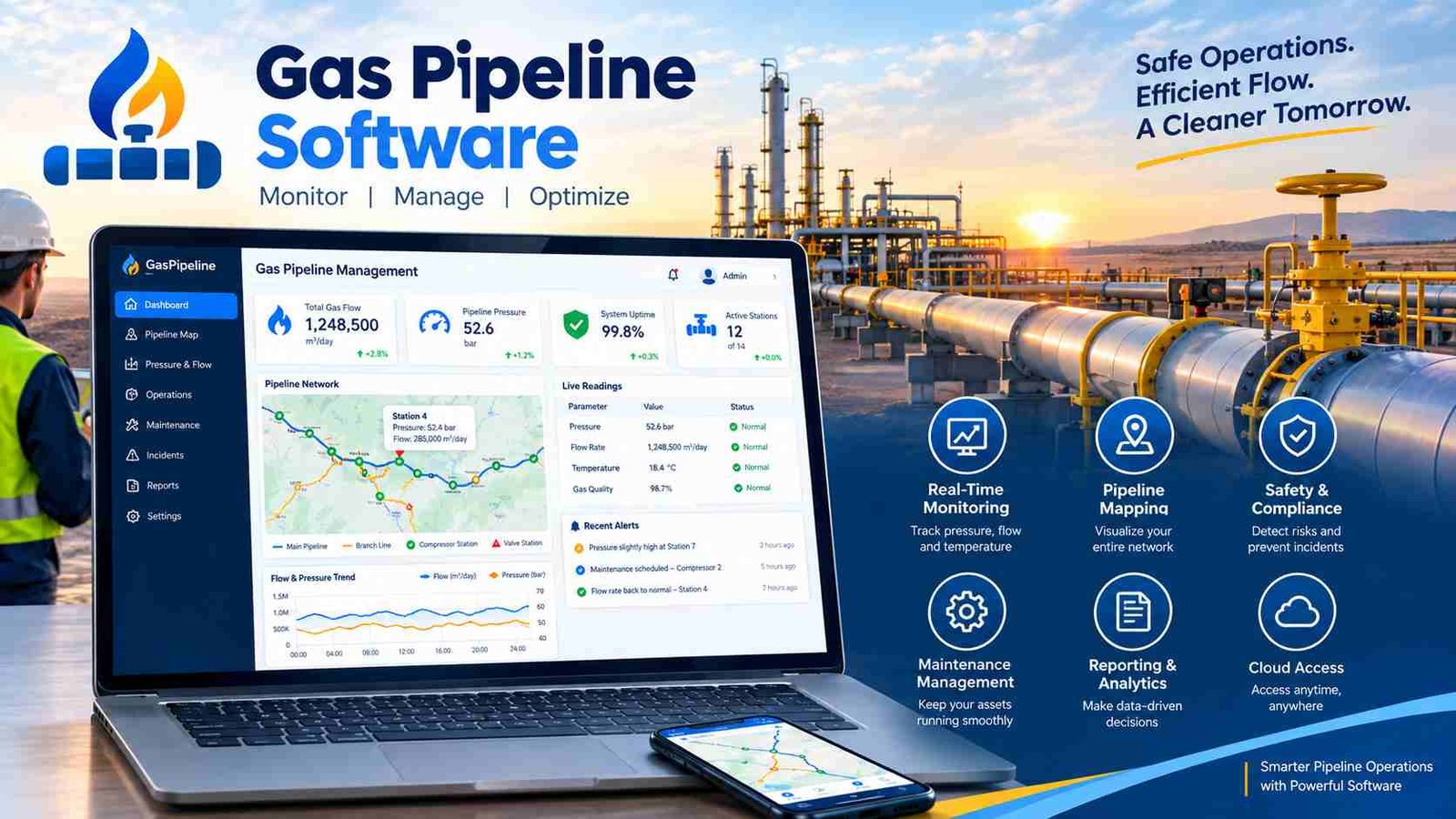
A live dashboard displays pressure levels, flow rates, valve status, alarms, and equipment health. If pressure suddenly drops or unusual flow patterns appear, the software automatically generates alerts for operators. These intelligent notifications help teams respond quickly, minimizing downtime and improving public safety. By combining GIS, SCADA, and operational analytics, gas pipeline software creates a complete digital view of pipeline performance.
Core Features of Gas Pipeline Software
The strength of gas pipeline software comes from its ability to combine many operational tools into one connected platform. Instead of using separate applications for mapping, maintenance, inspections, and reporting, organizations manage everything from a unified system.
One of the most valuable features is GIS pipeline mapping, which provides accurate digital maps of underground pipelines, valves, compressor stations, and customer connections. Engineers can instantly locate assets, visualize pipeline routes, and plan maintenance without relying on outdated paper drawings.
Another essential capability is SCADA integration. SCADA systems continuously collect operational data such as pressure, temperature, and flow rates. When integrated with gas pipeline software, operators gain both real-time monitoring and historical analysis within the same interface.
The software also includes comprehensive asset management, allowing every pipeline component to have its own maintenance schedule, inspection history, warranty information, and technical documentation. Work order management automatically assigns maintenance tasks to field crews, while mobile inspection apps enable technicians to complete inspections, capture GPS locations, upload photographs, and collect digital signatures even in offline environments.
Additional features include leak detection algorithms, pressure monitoring, valve and station management, engineering document storage, automated reporting, and performance analytics. Together, these tools improve operational efficiency while reducing manual administrative work.
Gas Pipeline Integrity Management Software
Pipeline integrity management focuses on preventing failures before they occur. Rather than reacting to leaks or equipment breakdowns, integrity software helps operators evaluate the health of pipelines throughout their entire service life.
What is pipeline integrity?
Pipeline integrity means ensuring that pipelines remain safe, reliable, and structurally sound. It includes corrosion monitoring, crack analysis, inspection planning, risk assessment, and repair prioritization. Integrity management software brings all of these activities together in one digital environment.
Corrosion, defects, and smart inspections
Corrosion is one of the leading causes of pipeline deterioration. The software tracks corrosion measurements over time, helping engineers identify areas where protective coatings or repairs are needed. Crack and defect analysis evaluates inspection data to determine whether flaws require immediate action or continued monitoring.
Inline inspection tools, commonly called smart pigs, travel inside pipelines to detect corrosion, dents, cracks, and metal loss. Gas pipeline integrity software imports these inspection results and compares them with historical records to identify deterioration trends.
Risk assessment and HCA analysis
Risk models evaluate factors such as population density, environmental sensitivity, pipeline age, operating pressure, and previous incidents. High Consequence Area (HCA) analysis helps operators prioritize inspections in locations where failures could have greater social or environmental impacts. Fitness-for-service evaluations then determine whether damaged pipeline sections can safely continue operating or require repair, extending asset life while maintaining safety.
SCADA vs GIS vs Gas Pipeline Software
Many people assume SCADA and GIS are competing technologies, but they actually serve different purposes. Modern gas pipeline software combines both systems into one operational platform.
| System | Primary Purpose |
| SCADA | Real-time monitoring and operational control |
| GIS | Spatial mapping and asset location |
| Gas Pipeline Software | Complete pipeline management integrating GIS, SCADA, maintenance, inspections, and analytics |
SCADA continuously collects live operational data from sensors, valves, and control stations. GIS provides accurate geographic information about underground assets and pipeline routes. Gas pipeline software connects these technologies with maintenance records, integrity data, work orders, and reporting tools. Instead of replacing GIS or SCADA, it creates a unified operational environment where engineering, field, and control room teams work from the same reliable information.
Benefits of Using Gas Pipeline Software
Organizations invest in gas pipeline software because it delivers measurable improvements in safety, productivity, and operational reliability. The greatest benefit is improved visibility across the entire pipeline network, allowing teams to make informed decisions using accurate, real-time information.
Safety improves because operators receive immediate alerts when abnormal pressure or flow conditions occur. Faster leak detection reduces environmental risk and shortens emergency response times. Maintenance also becomes more proactive, as the software schedules inspections based on asset condition rather than fixed calendars.
Regulatory compliance is another major advantage. Inspection reports, maintenance histories, audit trails, and engineering documents are stored digitally, making regulatory reporting faster and more consistent. Field technicians and office engineers collaborate more effectively because everyone accesses the same centralized database instead of exchanging spreadsheets through email.
Financially, organizations benefit from lower maintenance costs, reduced downtime, longer asset life, fewer duplicate inspections, and better resource planning. By replacing disconnected manual processes with connected digital workflows, gas pipeline software supports both operational excellence and long-term infrastructure reliability.
GIS Mapping in Gas Pipeline Software
GIS is the geographical foundation of modern pipeline management. Every underground asset must have an accurate location, making GIS one of the most important components of gas pipeline software.
Linear referencing allows operators to identify exact positions along a pipeline without relying only on street addresses. Engineers can locate valves, welds, crossings, and inspection points using precise measurements along the pipeline route. This improves maintenance planning and emergency response.
Pipeline route visualization displays transmission and distribution networks on interactive maps. Users can layer satellite imagery, land ownership, utility infrastructure, environmental zones, and engineering drawings for better planning decisions. Easement and right-of-way management helps companies track property boundaries, access agreements, and maintenance responsibilities across long pipeline corridors.
Modern GIS platforms also support utility network modeling, allowing engineers to analyze connectivity between pipelines, pressure zones, customers, and supply sources. Drone imagery and satellite mapping provide updated visual information for construction projects, vegetation monitoring, and post-disaster assessments. Together, these mapping capabilities create an accurate digital representation of the entire gas network.
Leak Detection and Real-Time Monitoring
Detecting leaks early is one of the most valuable capabilities of gas pipeline software. Advanced monitoring systems analyze operational data continuously instead of waiting for manual inspections.
Pressure-based leak detection compares expected pressure with actual measurements throughout the pipeline. A sudden pressure drop may indicate a leak, valve malfunction, or equipment failure. Flow imbalance monitoring works similarly by comparing gas entering and leaving different pipeline sections to identify unexplained losses.
Some systems also use acoustic monitoring, which detects sound patterns produced by escaping gas. Artificial intelligence improves accuracy by recognizing abnormal operating behavior that traditional threshold alarms may miss. Instead of generating unnecessary alerts, AI models learn normal pipeline conditions and identify meaningful anomalies.
When a potential leak is detected, operators receive automatic notifications through dashboards, mobile devices, and control room alarms. Emergency response teams can immediately view the affected location on GIS maps, access nearby asset information, and dispatch field crews with accurate location data. This combination of monitoring, mapping, and automated alerts significantly reduces response time and improves public safety.
Predictive Maintenance for Gas Pipelines
Predictive maintenance helps organizations repair equipment before failures become expensive emergencies. Rather than replacing components on fixed schedules, gas pipeline software analyzes historical and real-time data to predict future maintenance needs.
Inspection histories, corrosion measurements, pressure records, repair logs, and environmental conditions are combined to identify deterioration patterns. Machine learning models estimate corrosion growth and help engineers prioritize high-risk assets before they become critical problems.
Maintenance scheduling becomes more efficient because the software recommends inspections based on actual asset condition. Field teams receive automatically generated work orders with equipment details, location information, safety procedures, and previous inspection records.
Failure prevention reduces unexpected shutdowns, extends pipeline lifespan, and lowers maintenance costs by focusing resources where they create the greatest value. Although predictive analytics does not eliminate every risk, it gives operators a stronger foundation for planning maintenance strategically rather than reacting to failures.
Regulatory Compliance & Safety Standards
Pipeline operators must maintain detailed records to demonstrate safe operations and regulatory compliance. Gas pipeline software simplifies this responsibility by organizing inspections, maintenance activities, engineering documents, and audit histories in one secure system.
Inspection documentation becomes easier because field technicians record findings digitally instead of using paper forms. Every inspection includes timestamps, GPS locations, photographs, and technician signatures. Audit trails automatically record who modified data and when changes occurred, improving accountability.
Maintenance records provide complete histories for valves, regulators, compressor stations, and pipeline segments. Risk assessments help prioritize inspections based on operational conditions, while environmental reporting supports documentation for incidents, emissions, or protected areas where required.
Compliance requirements vary between countries and regulatory authorities, but digital workflows help organizations maintain consistent records regardless of jurisdiction. Instead of searching through filing cabinets during audits, operators can generate accurate reports directly from the software, saving time while improving data quality.
Mobile Apps for Field Pipeline Inspections
Field inspections are most effective when technicians can capture information directly at the work site. Mobile applications connected to gas pipeline software eliminate the need to rewrite handwritten notes after returning to the office.
Technicians can perform inspections offline in remote locations where internet connectivity is limited. GPS automatically records the exact inspection location, reducing mapping errors. Photographs document corrosion, coating damage, vegetation issues, and equipment conditions, creating visual evidence for future comparisons.
Digital signatures confirm completed work, while standardized inspection forms improve consistency across different teams. Once internet access becomes available, the application synchronizes all collected data with the central database. Office engineers immediately receive updated inspection results, allowing faster review and maintenance planning.
This mobile workflow reduces paperwork, improves accuracy, and strengthens communication between field crews and operations centers, making inspections both faster and more reliable.
Cloud vs On-Premise Gas Pipeline Software
Choosing between cloud and on-premise deployment depends on operational needs, security policies and available IT resources.
| Feature | Cloud | On-Premise |
| Deployment | Faster | Slower |
| Updates | Automatic | Manual |
| Remote access | Yes | Limited |
| Infrastructure | Vendor-managed | Company-managed |
| Scalability | High | Moderate |
Cloud-based software offers quicker deployment, automatic updates, easier remote collaboration, and lower infrastructure management. It is often ideal for organizations with distributed field teams and limited internal IT resources.
On-premise solutions provide greater control over infrastructure and may better suit organizations with strict internal security or legacy operational requirements. However, they typically require dedicated hardware, manual software updates, and higher maintenance costs. The best choice depends on operational priorities rather than assuming one deployment model is universally better.
Best Gas Pipeline Software Solutions
The market includes several categories of gas pipeline software, each designed for different operational priorities rather than a single best product.
Enterprise integrity platforms focus on corrosion analysis, smart pig inspections, risk modeling, and long-term pipeline health management. They are commonly used by large transmission operators managing extensive infrastructure.GIS-based pipeline management systems specialize in accurate mapping, linear referencing, asset location, right-of-way management, and utility network visualization. These platforms are valuable for engineering and planning teams.
SCADA operational systems prioritize real-time monitoring, control room operations, pressure monitoring, alarm management, and operational reliability. They are essential where continuous monitoring is critical.Digital twin platforms create virtual models of physical pipeline networks, allowing engineers to simulate operational scenarios, maintenance planning, and infrastructure performance.
Utility-focused asset management systems combine maintenance scheduling, inspections, inventory, mobile workforce management, and compliance reporting for gas distribution companies and municipal utilities. Organizations should select software based on operational requirements, integration capabilities, scalability, and long-term business goals.
How to Choose the Right Gas Pipeline Software?
Selecting the right solution begins with understanding your organization’s operational needs rather than comparing features alone. Large transmission companies often require advanced integrity management and SCADA integration, while smaller utilities may prioritize inspections, GIS mapping, and maintenance scheduling.
Compatibility with existing GIS systems is important because accurate geographic data forms the foundation of pipeline management. SCADA integration should also support real-time operational monitoring without creating duplicate data entry.
Organizations with mobile field crews should evaluate offline inspection capabilities, GPS accuracy, photo documentation, and synchronization speed. Compliance requirements vary by region, so reporting tools should match local regulatory expectations.
Finally, consider scalability. The software should support future network expansion, additional users, and new operational technologies without requiring complete system replacement.
Buyer checklist
- Support for GIS and SCADA integration
- Mobile inspection capabilities
- Integrity management tools
- Automated reporting and compliance
- Scalable cloud or on-premise deployment
- Strong cybersecurity and user permissions
Common Challenges During Implementation
Implementing gas pipeline software requires careful planning because technology alone cannot solve operational problems. The most common challenge is migrating legacy data from spreadsheets, paper records, and disconnected databases into one reliable system. Cleaning inaccurate or duplicate records before migration significantly improves long-term results.
Employee training is equally important. Engineers, field technicians, and control room operators must understand both the software and standardized workflows. Successful organizations typically provide phased training instead of expecting immediate adoption.
Integration with existing SCADA, GIS, ERP, and maintenance systems may require technical configuration, but strong integration reduces duplicate data entry and improves operational consistency. Data quality should also be monitored continuously through validation rules and regular audits.
Cybersecurity deserves special attention because pipeline infrastructure is critical infrastructure. Modern software should include role-based access, encrypted communications, secure authentication, and regular security updates to protect sensitive operational information.
Future Trends in Gas Pipeline Software
The future of gas pipeline software is becoming increasingly intelligent through artificial intelligence, IoT connectivity, cloud computing, and digital twin technology. Instead of simply storing information, software is evolving into a decision-support platform that helps operators predict risks and optimize infrastructure performance.
Machine learning improves risk prediction by identifying subtle patterns in pressure, flow, corrosion, and inspection data. Digital twins create virtual pipeline models for testing maintenance strategies without affecting live operations. Expanding IoT sensor networks provide continuous monitoring across larger sections of pipeline infrastructure.
Drone inspections are reducing the time needed to monitor remote right-of-way corridors, while cloud-native platforms improve collaboration between geographically distributed teams. Predictive analytics will continue helping operators prioritize maintenance, reduce operational costs, and strengthen pipeline safety through smarter data-driven decisions.
Frequently Asked Questions
1. What is gas pipeline software used for?
Gas pipeline software is used to manage pipeline assets, monitor operations, schedule maintenance, track inspections, detect leaks, and maintain accurate GIS and compliance records.
2. Can gas pipeline software work without an internet connection?
Yes. Many systems include offline mobile apps that allow field technicians to complete inspections, capture GPS locations, and upload photos. The data synchronizes automatically once connectivity is restored.
3. Why is GIS important in gas pipeline software?
GIS provides accurate digital maps of underground pipelines, valves, and utility assets. It helps engineers locate infrastructure quickly, plan maintenance, and improve emergency response.
4. What industries benefit most from gas pipeline software?
Natural gas transmission companies, gas distribution utilities, midstream energy operators, municipal gas networks, and pipeline construction contractors all benefit from specialized pipeline management software.
5. Is gas pipeline software suitable for small utility companies?
Yes. Many modern platforms offer scalable solutions for both small utilities and large enterprise operators, allowing organizations to choose features that match their network size and operational needs.
Conclusion
Gas pipeline software has become an essential technology for modern natural gas operations. By combining GIS mapping, SCADA monitoring, integrity management, inspections, maintenance, and reporting into one connected platform, it helps organizations improve safety, reduce downtime and manage infrastructure more efficiently.
The best solution is not simply the one with the most features. It is the platform that fits your operational needs, integrates with existing systems, supports regulatory compliance, and provides accurate data for better decision-making. As pipeline networks become more complex, digital software will continue playing a vital role in delivering safe, reliable, and efficient natural gas services.